Office design is not just desks and conference rooms. It is one of the most significant statements a company can make to reinforce and define its brand in the eyes of employees and customers. It speaks volumes to the people who work there, the clients who visit, and future talent deciding where they want to be. The most effective workplace interiors carry a clear sense of identity and bring people into the office around a shared mission.
The case for investing in workplace design is substantive. Gallup’s 2026 State of the Global Workplace report found that only 20% of employees worldwide were engaged at work last year, costing the global economy an estimated $10 trillion in lost productivity. The physical environment is one of the most direct drivers of that engagement, and one of the most within a company’s control. JLL’s 2025 Workforce Preference Barometer, surveying nearly 9,000 employees across 31 countries, identifies what the right office environment needs to support: inspiration, space to recharge, and genuine connection. The office has become a deliberate investment in culture, talent, and the experience of work.
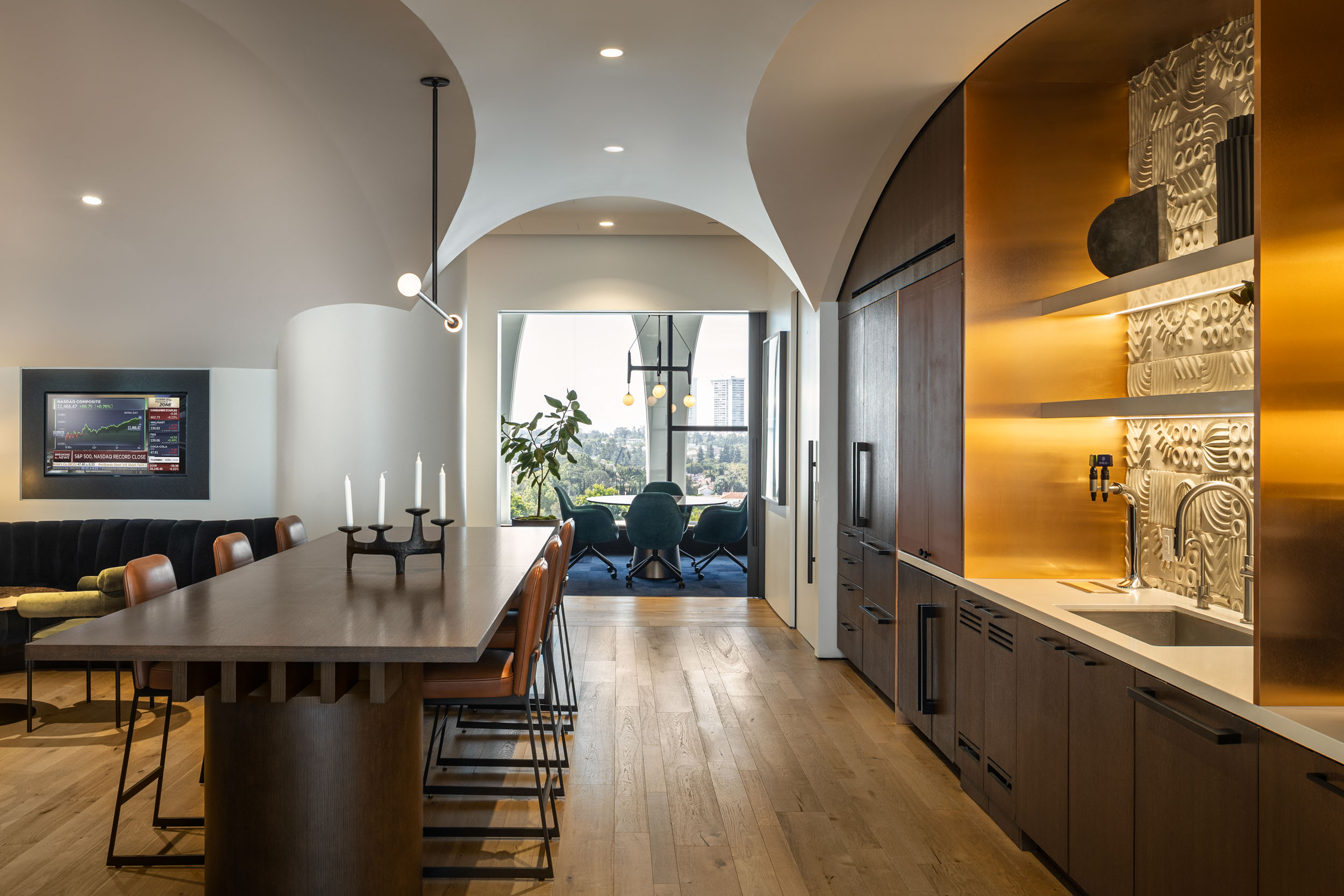
A hospitality-inspired kitchen anchors the office’s social space, with warm wood cabinetry, curated art, and a communal dining table for gathering.
RIOS brings a depth of practice shaped by how people experience and move through space. Across projects, the focus is on how people gather, circulate, and interact, including the informal exchanges that happen between scheduled work. That perspective informs how RIOS approaches workplace design, where atmosphere, material, and circulation all contribute to how a space functions and how work unfolds within it.
“What distinguishes our approach to designing bespoke offices is that it starts directly with a company’s ethos,” says Melanie Freeland, Partner at RIOS. “From there, our multidisciplinary process considers the project across multiple scales simultaneously, ensuring the result is fully integrated from material detail to spatial experience.”
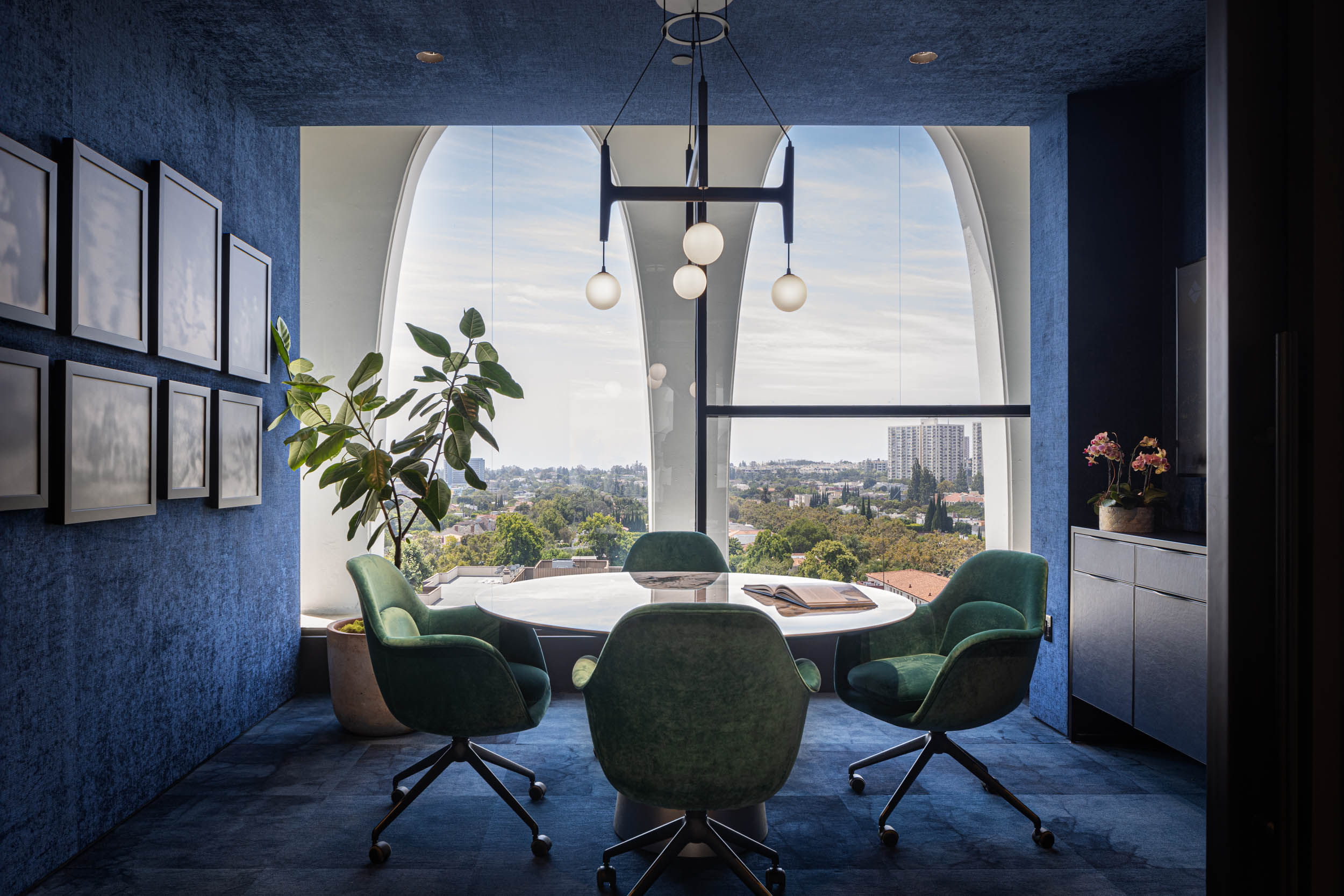
Deep blue textured walls and green velvet seating frame a meeting room overlooking the Los Angeles skyline.
Signature Moments in Bespoke Office Design
The strongest workplace interiors are defined by decisions that are specific to each client, each company, and each brand. Identity builds through space itself, through proportion, materiality, and the experience of arrival. These moments become anchors in how people gather, move, and remember a workplace.
This is most visible when architecture becomes a framework for the interior. In Beverly Hills, within Edward Durell Stone’s landmark New Formalist building, the bespoke Financial Offices occupy a space where the existing arched façade becomes interior expression. Those forms define gathering areas, private offices, and circulation throughout. The result is sophisticated, timeless, and unmistakably connected to place through continuity with the architecture.
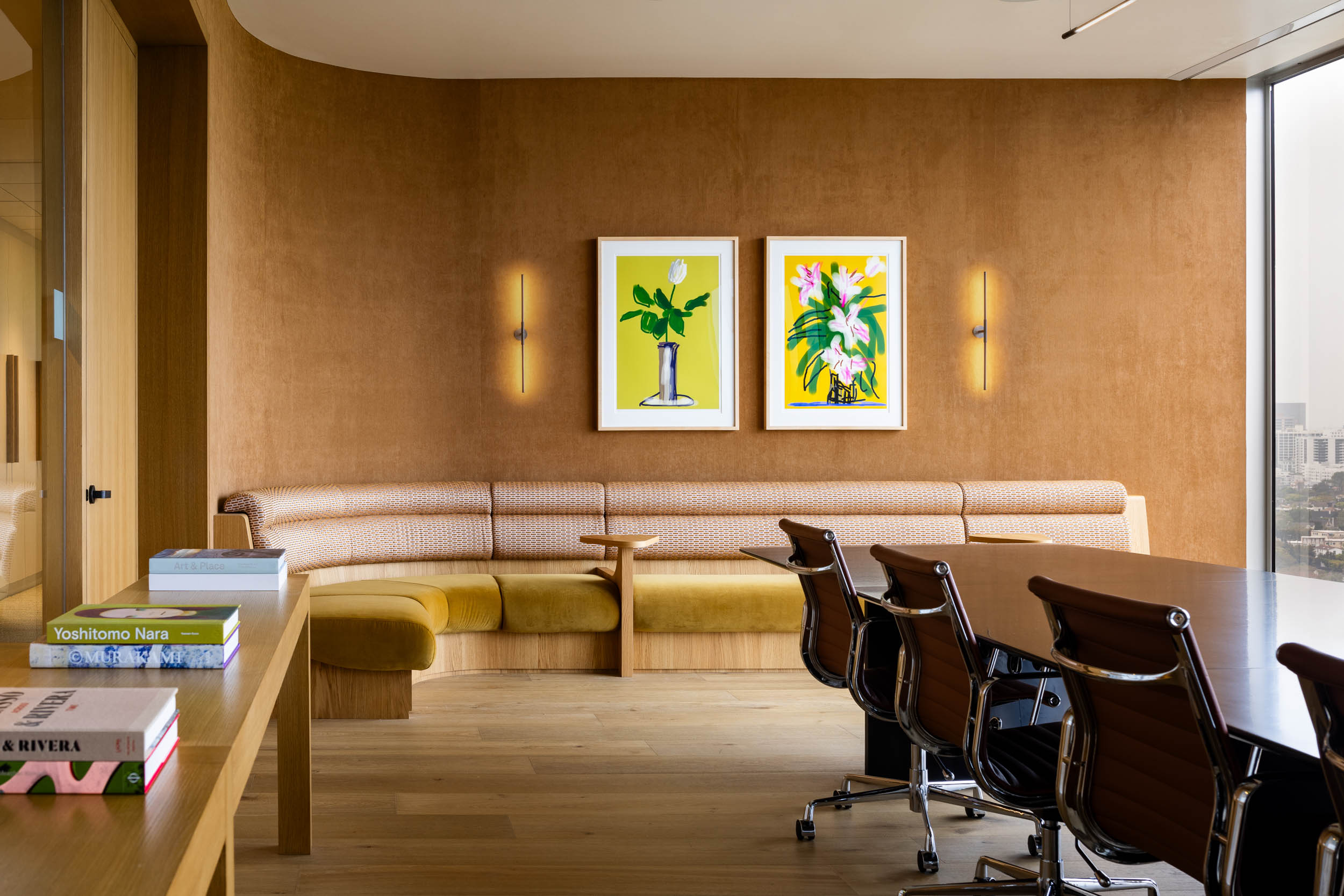
RIOS designed custom banquettes with integrated side tables and charging stations, extending functionality into every corner of the workplace.
Custom Interiors Shaped by Culture and Collection
A different kind of precision defines Bellco Capital Family Office in Los Angeles. Here, the workplace is shaped through culture and continuity. The space unites seven distinct business entities under one family office. Custom curved banquettes extend the language of the client’s mid-century art collection into the interior. Wood fluting, polished quartzite, and upholstered surfaces bring depth and warmth to shared areas. Across this single floor shared by multiple business interests, the design maintains a consistent spatial tone anchored in a residential design feel.
At the Offices of the David Bohnett Foundation and Baroda Ventures, a corner suite in Beverly Hills’s Golden Triangle, curated furniture, custom millwork, antiques, and art displays give the space the character of a privately assembled interior. Warm wood finishes, fabric-wrapped walls, and eye-level lighting draw from the aesthetic of Gio Ponti and mid-century design. The office serves as a welcoming hub for clients and donors, with a residential quality present in every detail.
“Custom furniture is where function and feeling come together,” says Mehmet Can Gumus, Senior Project Designer at RIOS. “Every piece is a response to how that specific client works. When those decisions are made carefully, and considered alongside art and planting, the space feels effortless. That’s what makes people settle into it.”
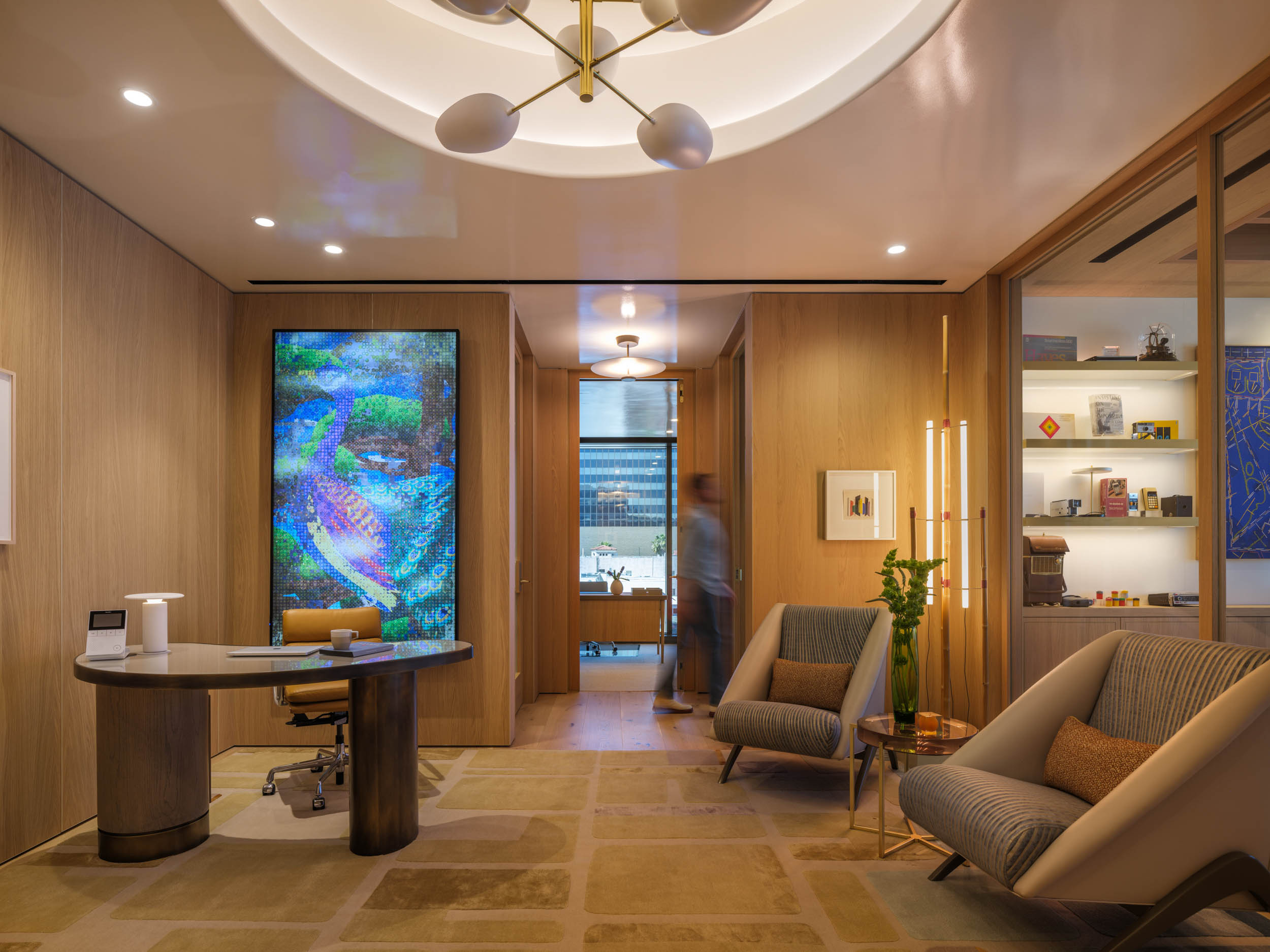
Artwork and warm wood paneling define the suite alongside a brass ceiling fixture, giving the office the feeling of a privately assembled interior.
Biophilic Office Design
The relationship between interior space and landscape has a direct impact on employee wellbeing. Natural systems influence how people focus, recover, and move through the working day. As a result, the most effective workplaces embed biophilic design into their spatial and material decisions from the outset, so that environment and productivity continuously inform one another.
This approach is evident in Tishman Speyer’s headquarters at Rockefeller Center. RIOS organized interior planting as a structured ecological system, developed as a layer of A+I’s workplace layout. Three distinct habitats define the workplace. Sun-responsive plantings line the perimeter. A shade-adapted interior grove anchoring collaboration zones. Layered transitional planting connects the office environment. The palette draws from Manhattan’s native ecosystems and aligns with WELL Building Standards, so that the interior landscape actively supports focus and wellbeing throughout the day.
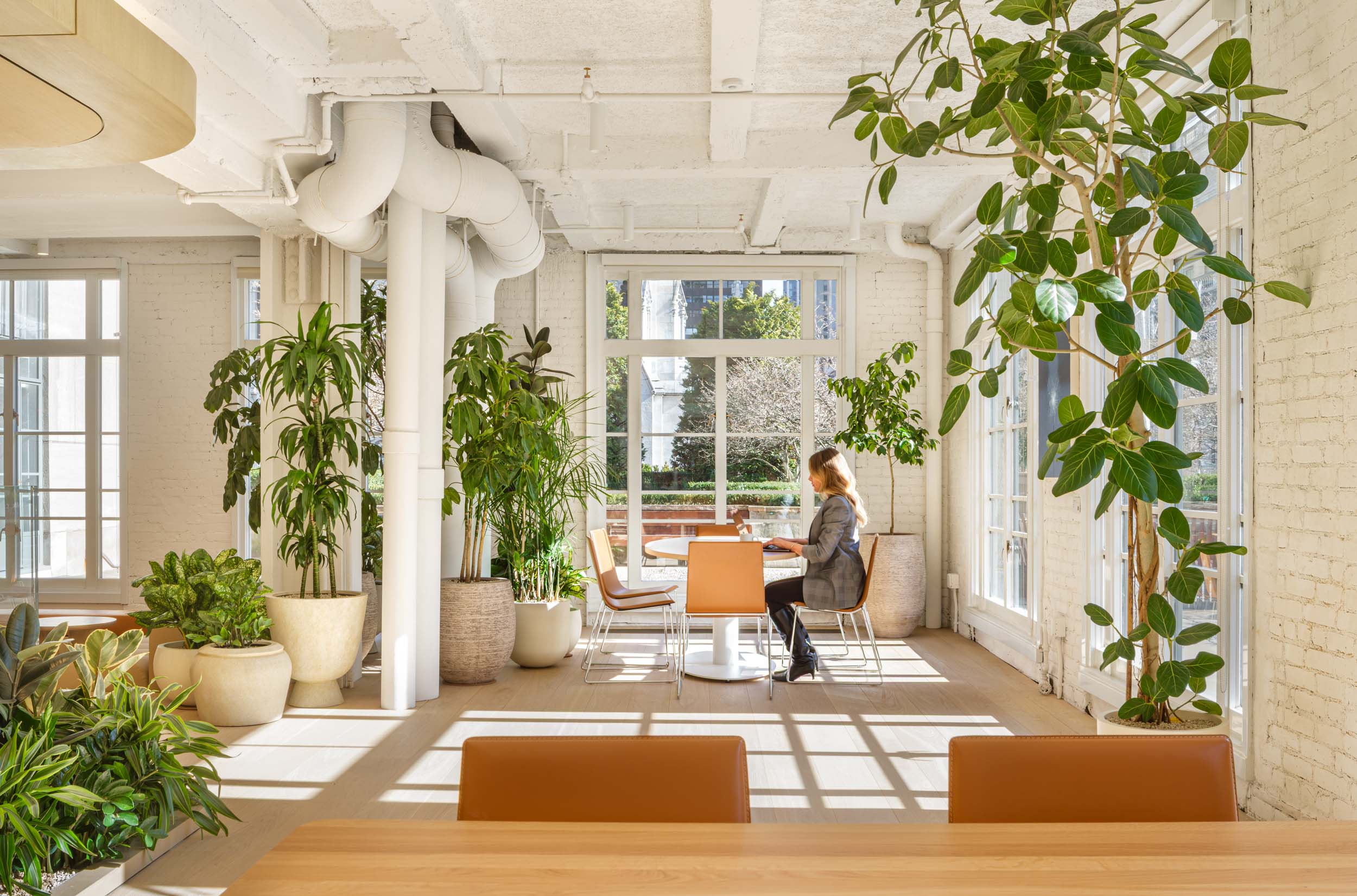
Full-height trees and layered planting at Tishman Speyer’s Rockefeller Center headquarters create a workspace where nature is present at every scale.
In Beverly Hills, UTA Bungalows extends that thinking across an entire campus. Three interconnected buildings house the global talent agency, each carrying their own interior character. Warm materials, art-centered workspaces, café experiences, and integrated planting bring a residential quality to each building. Courtyards with the sound of water, shaded outdoor work areas, and lounge seating connect the campus through landscape. The movement between inside and outside becomes a natural part of the daily experience.
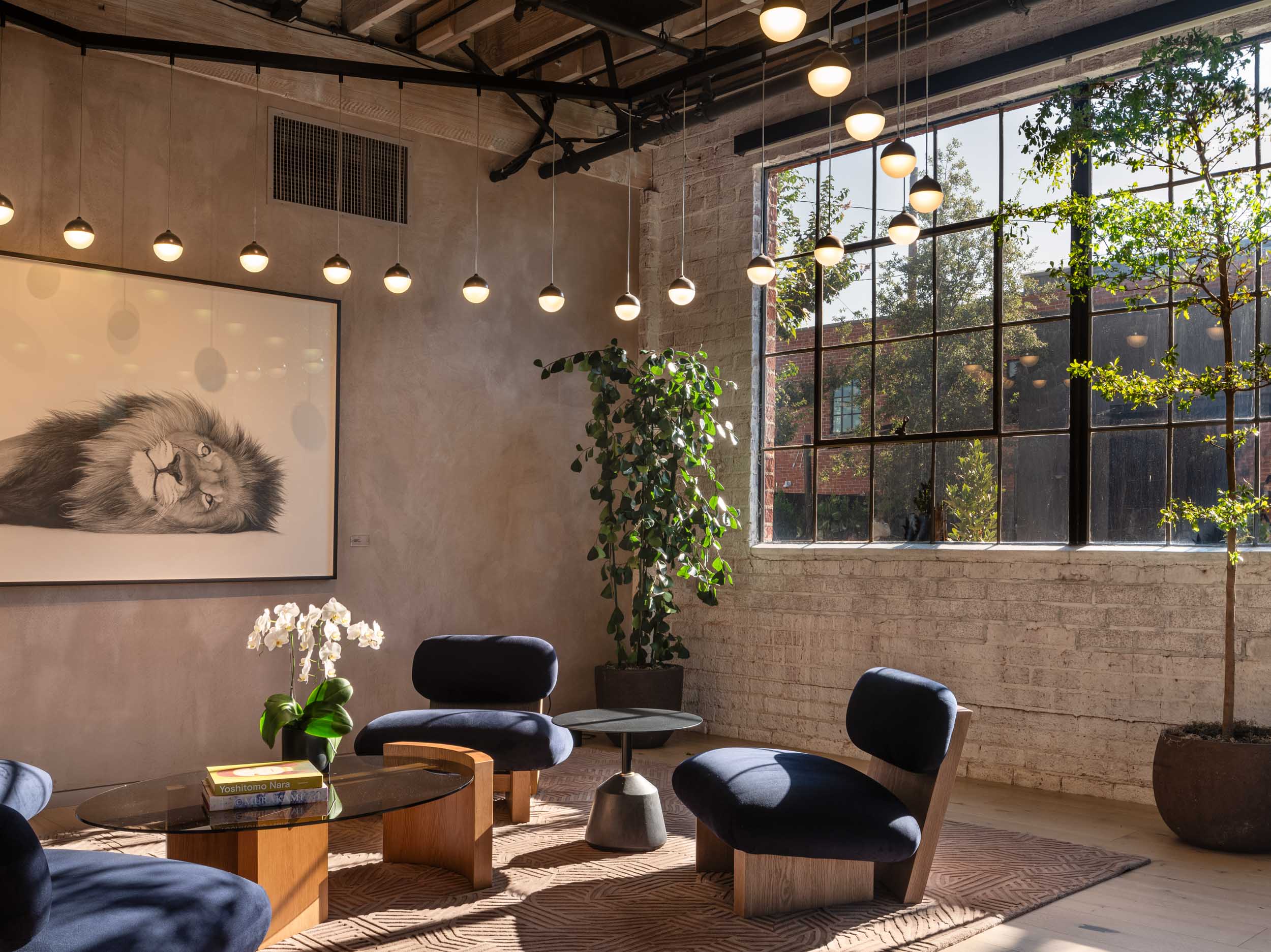
Sculptural lounge chairs, exposed brick, and large-scale artwork shape the interiors at UTA Bungalows.
Materials and Textures in Custom Workplace Interiors
Material decisions are among the most direct ways a workplace communicates value. A well-chosen material carries meaning over time. It ages, softens, and accumulates character through use. Many of the qualities people associate with home—comfort, warmth, privacy—are increasingly present in workplace interiors designed for long-term occupation.
The Century City Offices in Los Angeles are grounded in a hyperlocal context of Southern California. Local artisans produced the furniture, lighting, and rugs. Warm wood, varied stone, and coffered ceilings define spatial moments within the open floor. High ceilings and perimeter glazing bring natural light deep into the workplace, maintaining a continuous relationship between interior and city. Custom furniture pieces integrate technology with craftsmanship, concealing power and data while preserving a refined, uncluttered atmosphere. A layered selection of personal art, sculptural plants, and natural materials brings warmth and intimacy to the office.
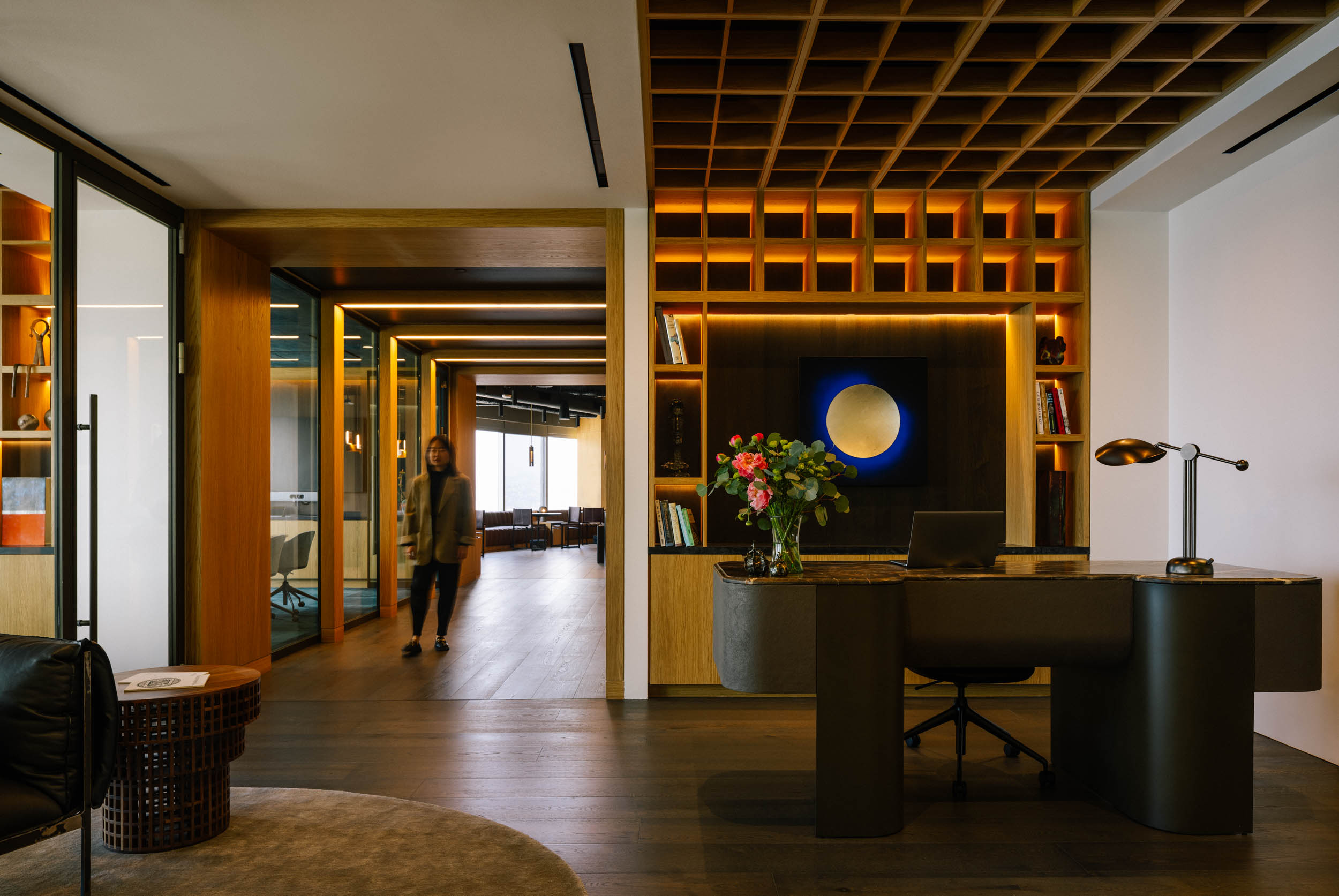
Warm wood, a backlit coffered ceiling, and a glowing circular artwork lend the Century City Offices a distinct visual identity.
Similarly, Golden Concord in Hefei’s Shushan Innovation Park demonstrates how material thinking translates across cultural contexts. Metallic finishes meet textured terracotta and glazed tile surfaces across six levels. The building shifts from public showcase and gathering spaces at the base to more focused work environments above. The contrast between reflective and earthy, tactile materials gives each level a distinct character. The workplace is specific to its place, its culture, and the people who use it.
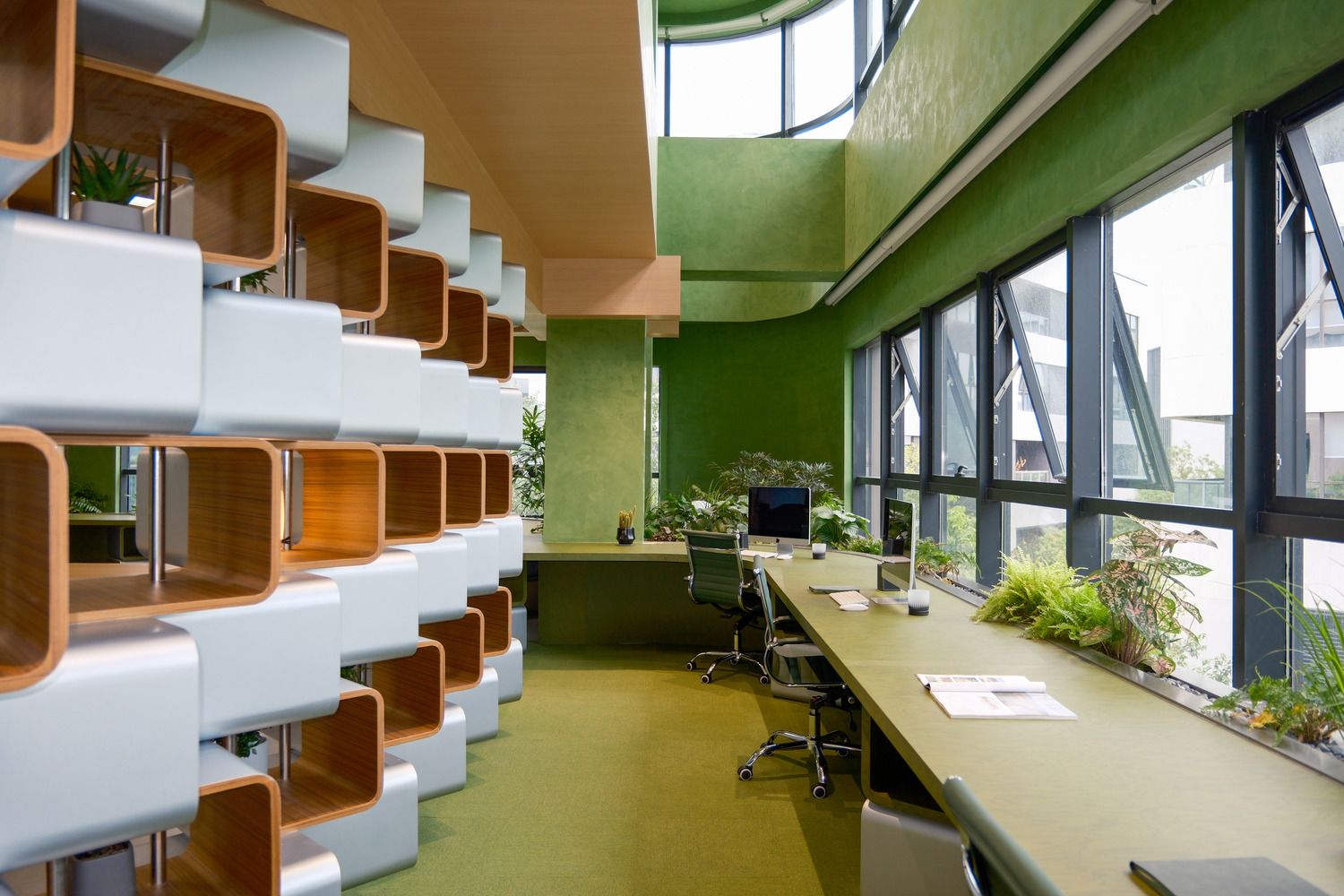
At Gold Concord, integrated planting runs the length of the workspace alongside a sculptural shelving system and saturated green surfaces.
What Integrated Workplace Design Delivers
The offices being commissioned today will shape how organizations attract talent, host clients, and build culture for years to come. Workplace environments influence people over time and the most successful interiors reflect the accumulation of decisions that shape how people move, focus, and connect each day.
Getting that right requires a practice that can work across all scales at once, from material detail to spatial sequence to the influence of nature and landscape. RIOS brings architecture, interiors, and landscape together as a single approach, applying that range to every workplace. The result is space that actively shapes how work happens.
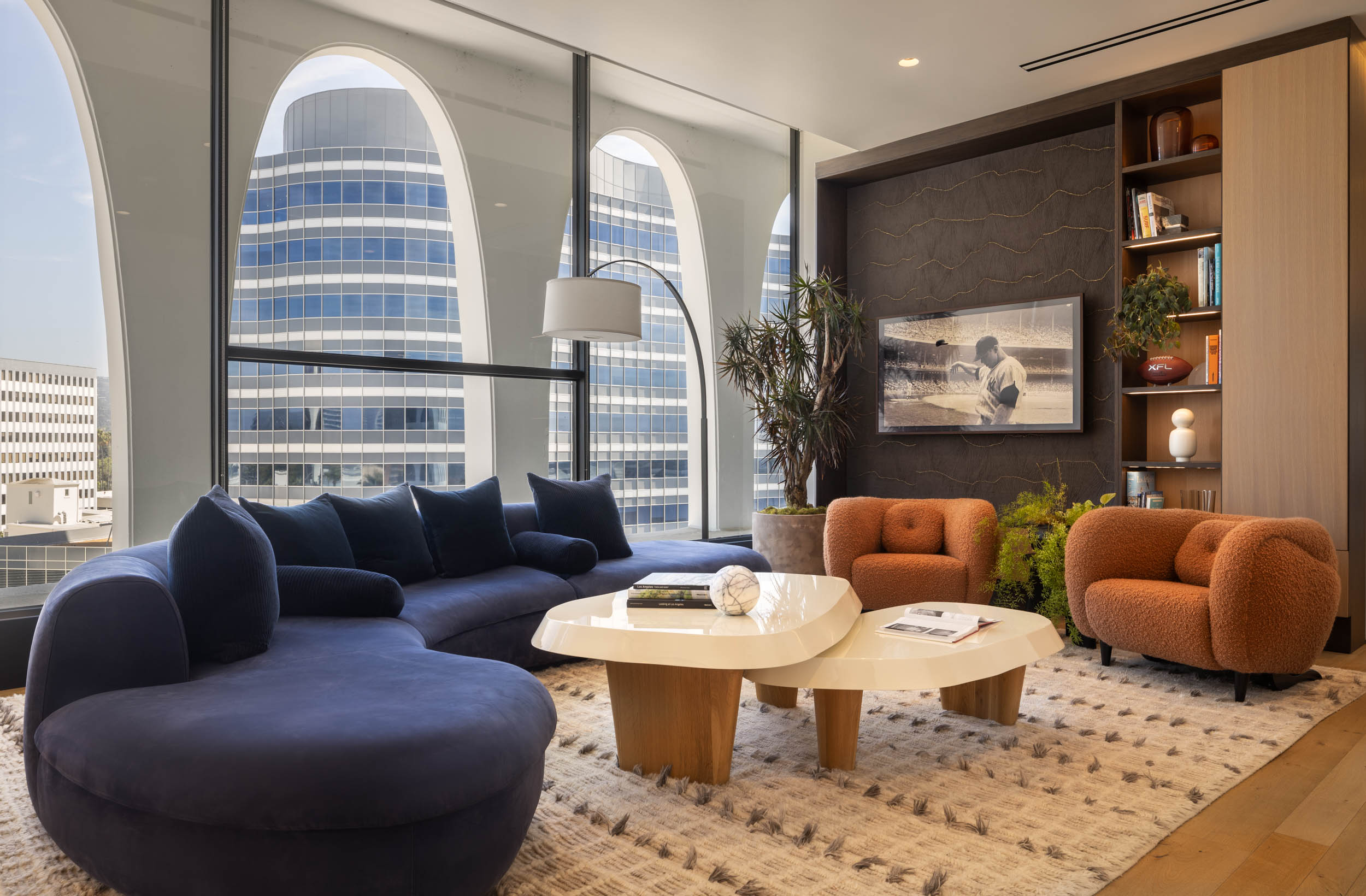
The personally curated interiors at the Financial Offices give the lounge the ease of a residential living room, framed by the building’s signature arches.