For the latter half of the 2010s and into the 2020s, the workplace was all about feeling at home. Businesses sought offices that felt less like the sterile, windowless grids of Severance and more like immersive, hospitable places to get work done—in warm lighting, soft seating, and a more casual atmosphere. While the move toward hospitality hasn’t gone anywhere, a new movement is emerging, as offices increasingly become places where storytelling happens. In other words, the era of the content creation workplace has arrived.
“Workplaces are being asked to deliver so much more than they ever have,” notes Dami Olufowoshe, Associate Principal, Senior Architect (“and workplace design lead”) for the US at RIOS. “Work isn’t meant to just be a re-creation of your home. Today, it’s about generating community and identity.”
Not only that, but in a post-Covid landscape, workers are closely monitoring ROC—”return on commute”—for being called back to the office. “The content creation lab is one of the many tools we’re seeing businesses use to attract staff back into the workplace,” says Manuel Freire de Andrade, RIOS’s Senior Associate for Architecture in the UK. “It signals to them that their working environment is positioned toward the future, not the past.”
It isn’t just media brands that are seeking out creator spaces. As the LA Times has discussed, brands and institutions are publishers now, too, producing video, podcasts, and other content that keeps their work and services relevant to their audience. Moving beyond predictable features like gyms, patios, and lounges, commercial and residential developers now sweeten their in-building amenities packages with podcast studios and other production facilities that can support tenants’ content creation needs.
And this movement is only growing: The creator economy is expected to reach half a trillion dollars by 2027. Against this backdrop, one of the biggest risks a business owner can take is designing a workplace that can’t keep up—or one that’s optimized for a world already in the rear-view mirror.
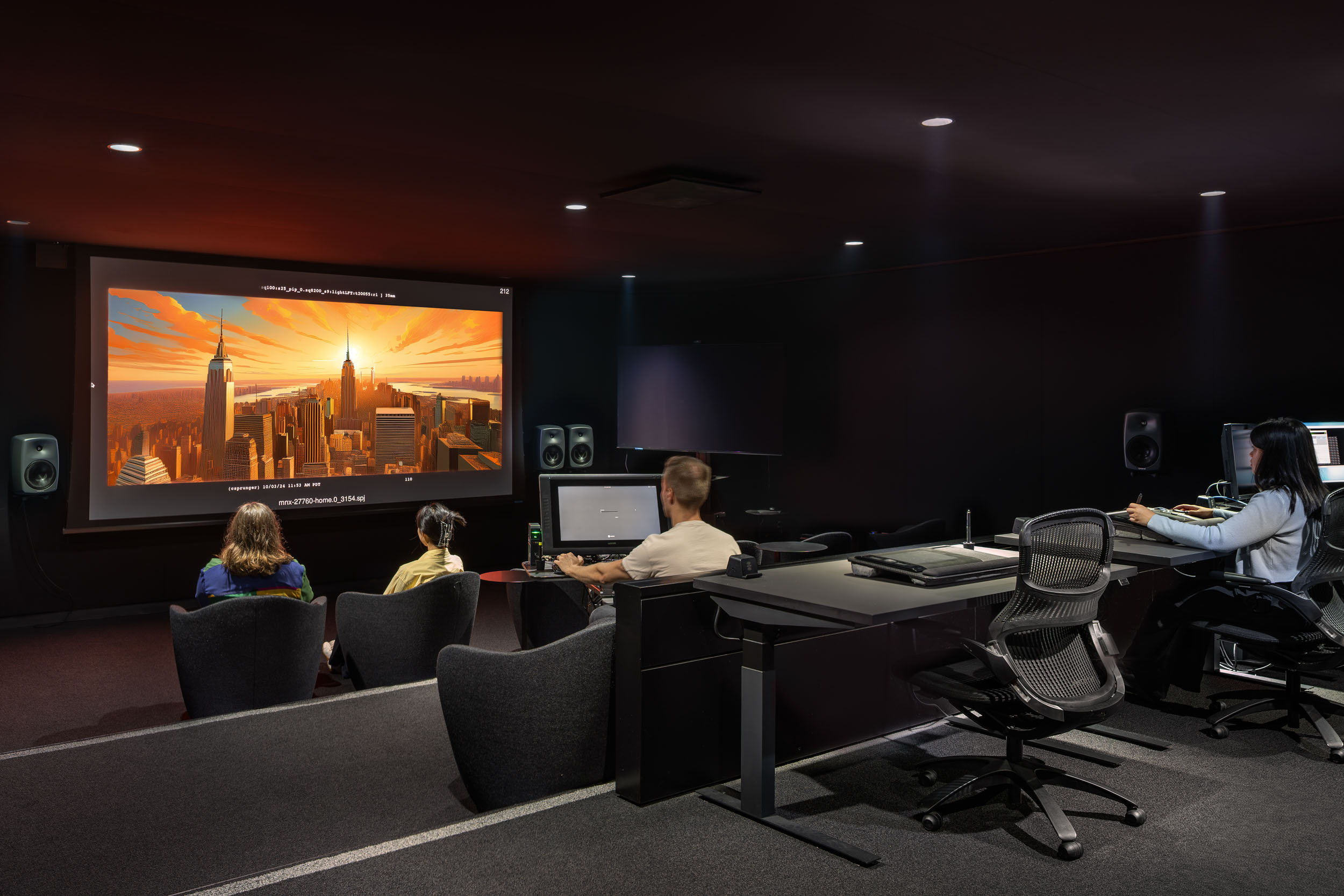
A production suite at Sony Pictures' Mid-Wilshire Campus supports content workflows from review to post-production.
The Evolution of Content
Content is changing fast. So is how it gets made, and consumed. The trends are clear: Storytelling is shifting toward high-volume, short-form content. Vertical video is also making up a greater portion of the ecosystem, pushing even legacy media brands to adopt quick-clip, portrait-orientation series formally into their lineups. (Disney+, for one, recently launched “Verts,” their own vertical franchise, lending its extensive archive to the effort.)
One recent Deloitte survey found that the average consumer spends six hours per day engaging with media and entertainment, including TV and movies, streaming video, music, and user-generated content. Podcast consumption is at an all-time high: Over the past decade, the total time that audiences older than 13 spent listening to podcasts has swelled by 355%—that’s 773 million hours per week—and increasingly, video is a part of that landscape, too.
Layered on top of those stats is the fact that platforms more generally are shifting toward creator-led content. With relatively low overhead compared to traditional production, as well as robust, built-in audience, this creator-led storytelling is making up more and more of media: Major institutional players like Netflix are dabbling in the genre, and influencers are supplementing historically reporter-led events like televised red-carpet interviews. And this content is being produced at an unprecedented scale and pace, thanks to the proliferation of AI platforms and accessible capture and editing tools.
Infrastructure to support this growing industry, then, is unsurprisingly in demand—whether it’s an extension of an existing workplace or one built entirely anew. Examples exist across the globe: Filmology Labs, a $250-million film and content production studio planned in Paterson, New Jersey, was announced earlier this year; Cloud 11—a large-scale creator hub in Bangkok, is due to launch in the fall; and Spotify’s own video-production facility, Sycamore Studios, just opened.
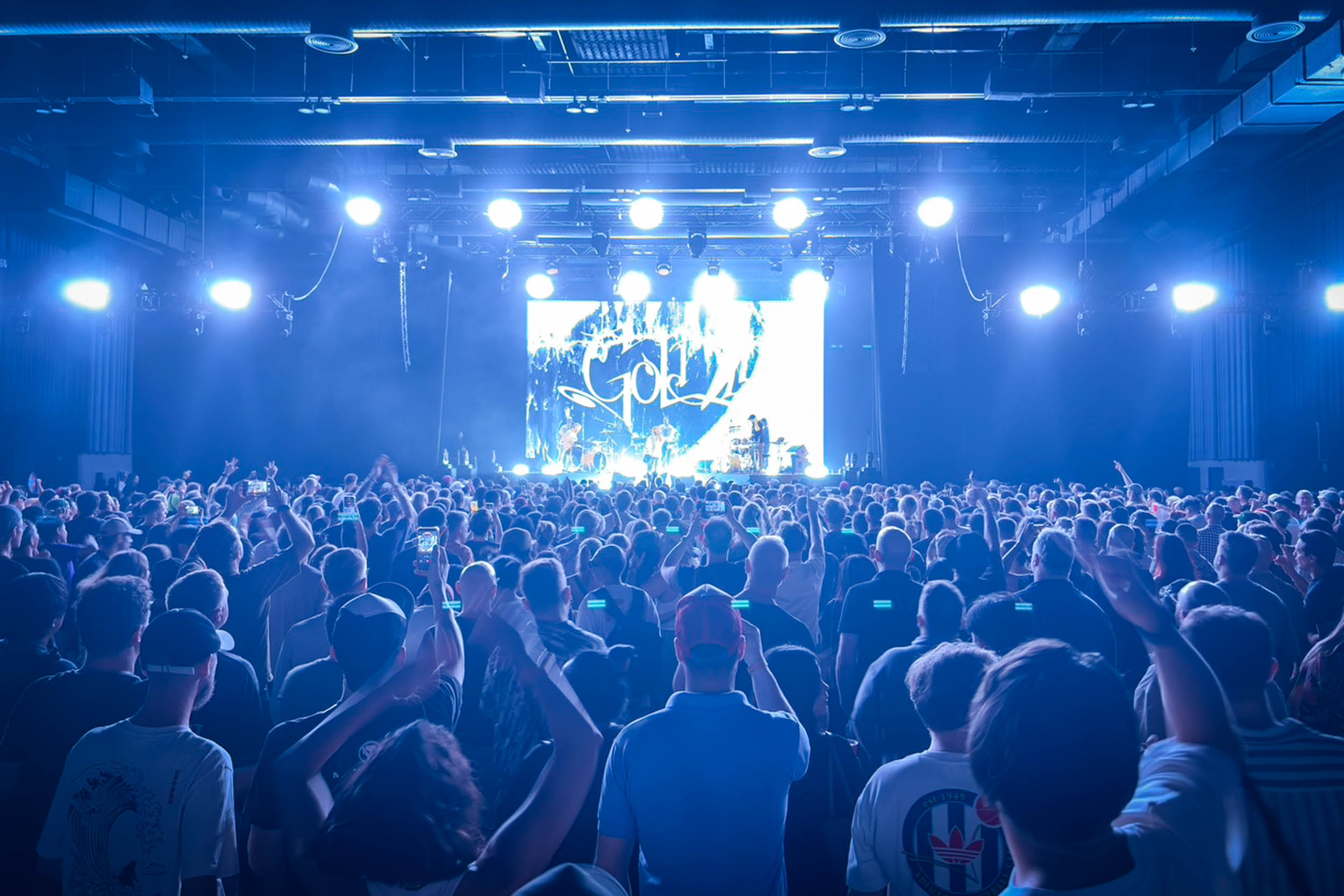
The Cloud 11 Creator Studio & Hall, Bangkok, hosting a live performance.
As the maker of some of the world’s leading content creation workplaces and a longtime collaborator on studio and soundstage design (FOX FUTURE Studio Lot Master Plan, NBCUniversal Vision Plan, Television City Tomorrow, Paramount Pictures Master Plan), RIOS knows intimately what it takes to make these unique environments tick. Whether it’s a video production workspace, a podcast studio, or a music recording complex, there are certain challenges that a space needs to meet—such as supporting the varied schedules and collaboration styles of its users, embedding powerful technical systems, and offering sites for anticipated and more improvisational creative exchange.
For RIOS, this all takes shape as an integrated system through the studio’s signature unsiloed approach to media workplace design. “We focus on blending hospitality with high-performance technology, in a continuous ecosystem where the core output is culture, music, stories, and media,” says Olufowoshe.
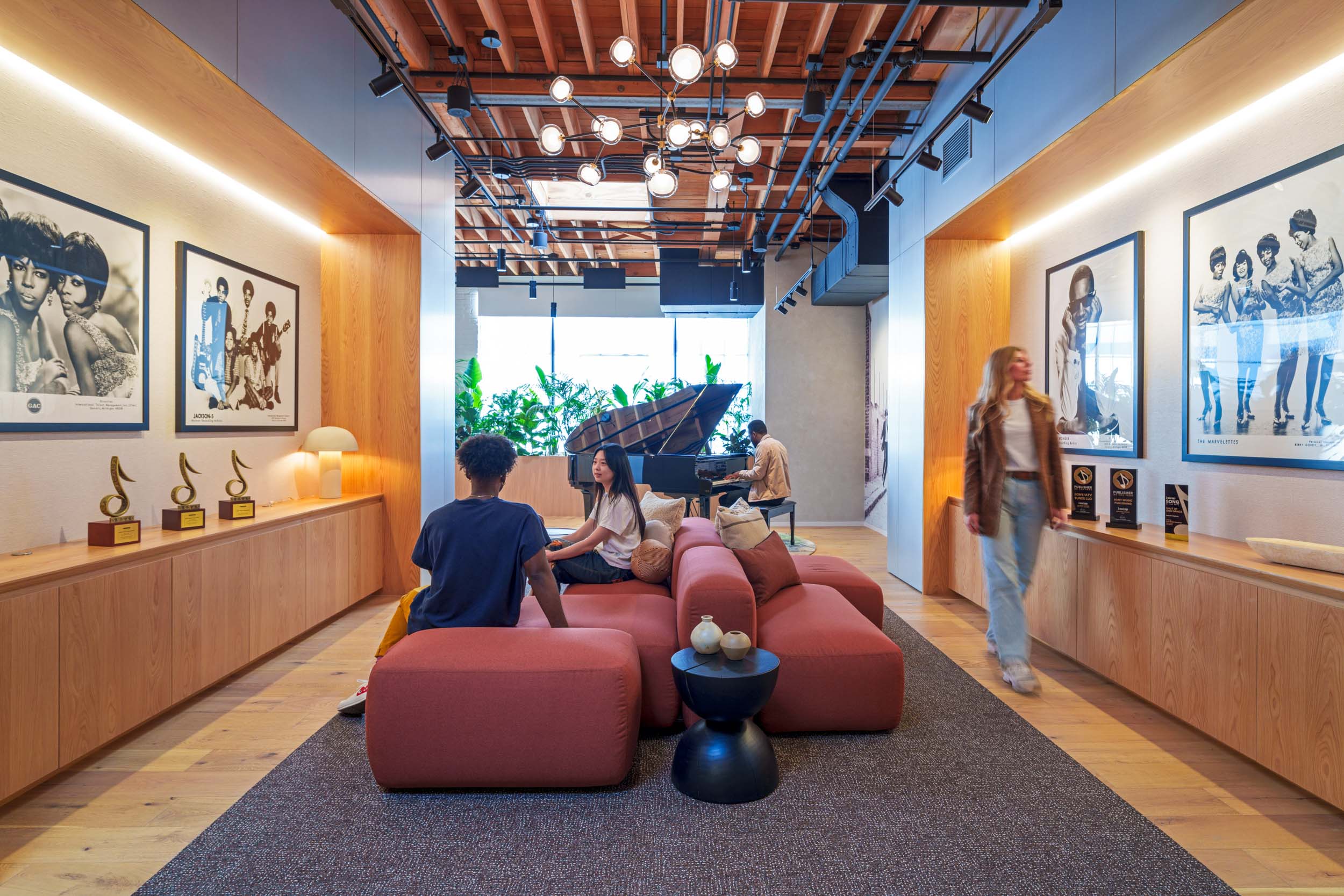
Reception at Sony Music Publishing, featuring artist photography, Grammy awards, and a grand piano — the label's catalog embedded in the space.
Meeting Creators Where They Are
Creativity doesn’t stick to 9-to-5 hours. Nor does it arrive on command. Days can include periods of drift, intense focus, and collaboration—each a necessary part of making something new. Rhythms can vary wildly: A guitarist might do her best work in the wee hours, while a singer-songwriter prefers the middle of the day. In a setting like Sony Music Publishing, the building needs to accommodate both, alongside staff and executives conducting more traditional desk work. Designing a content campus begins with recognizing that the best ideas sometimes happen outside of prescribed schedules.
Those different working styles (and hours) have direct spatial implications. Access, security, and building operations must be able to stand up to a round-the-clock productivity schedule. At Sony Music Publishing, this thinking informed RIOS’s approach to programming and adjacencies: executive suites, staff desking, and artist studios are each discretely zoned but interconnected, so every user group can work on their own terms while remaining part of a team.
Variability isn’t just about time, though: It’s also about managing the physical conditions that best support a creator’s process. In interviews, RIOS learned that songwriters’ preferred working conditions run the gamut from zen spaces bursting with natural light to highly closed-off enclaves where the craft is the sole focus. For a studio space to serve the two—and everything in between—RIOS devised tunable environments that users can align with their own needs.
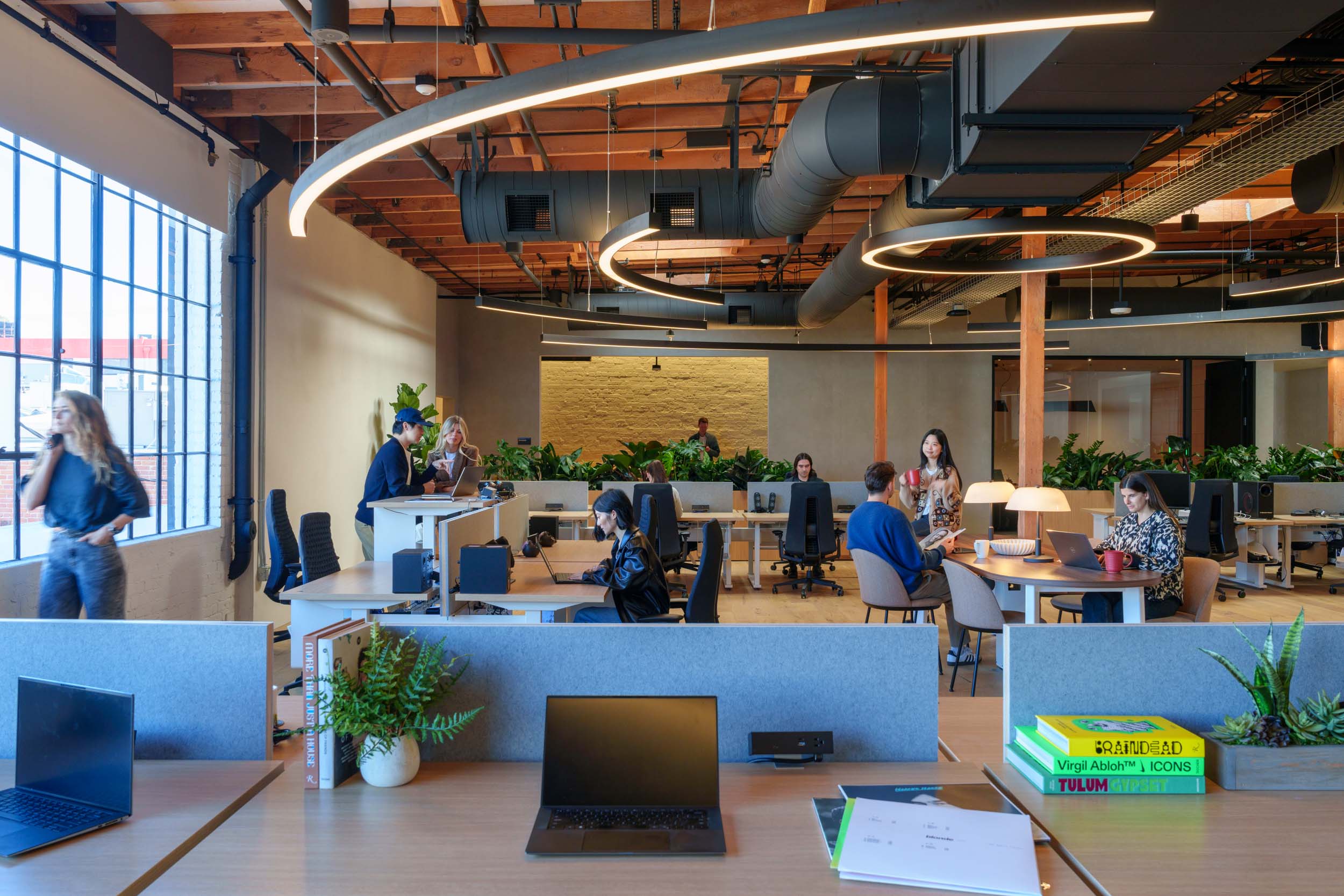
A light-filled open workspace at Sony Music Publishing supports the full spectrum of creative work.
Creative work also depends on achieving the right mix of connection and separation. In content-driven companies, different roles operate under different constraints, timelines, and pressures. From RIOS’s research into video-production workspaces and music studios, it became evident that artists and creators need privacy, autonomy, and some degree of insulation in order to do their best work—while still being able to interface with each other between sessions.
This is where a layout can be a content campus’s best ally: Spatial organization at Sony Music Publishing, for instance, balances access with discretion. Studios and talent spaces are separate from executive and corporate ones, helping creators feel supported during critical working hours, rather than under the microscope. Discrete “anchor zones” for different user groups—including private entrances for artists—enable individuals to move directly into their focus areas without passing through the office’s other operational activity.
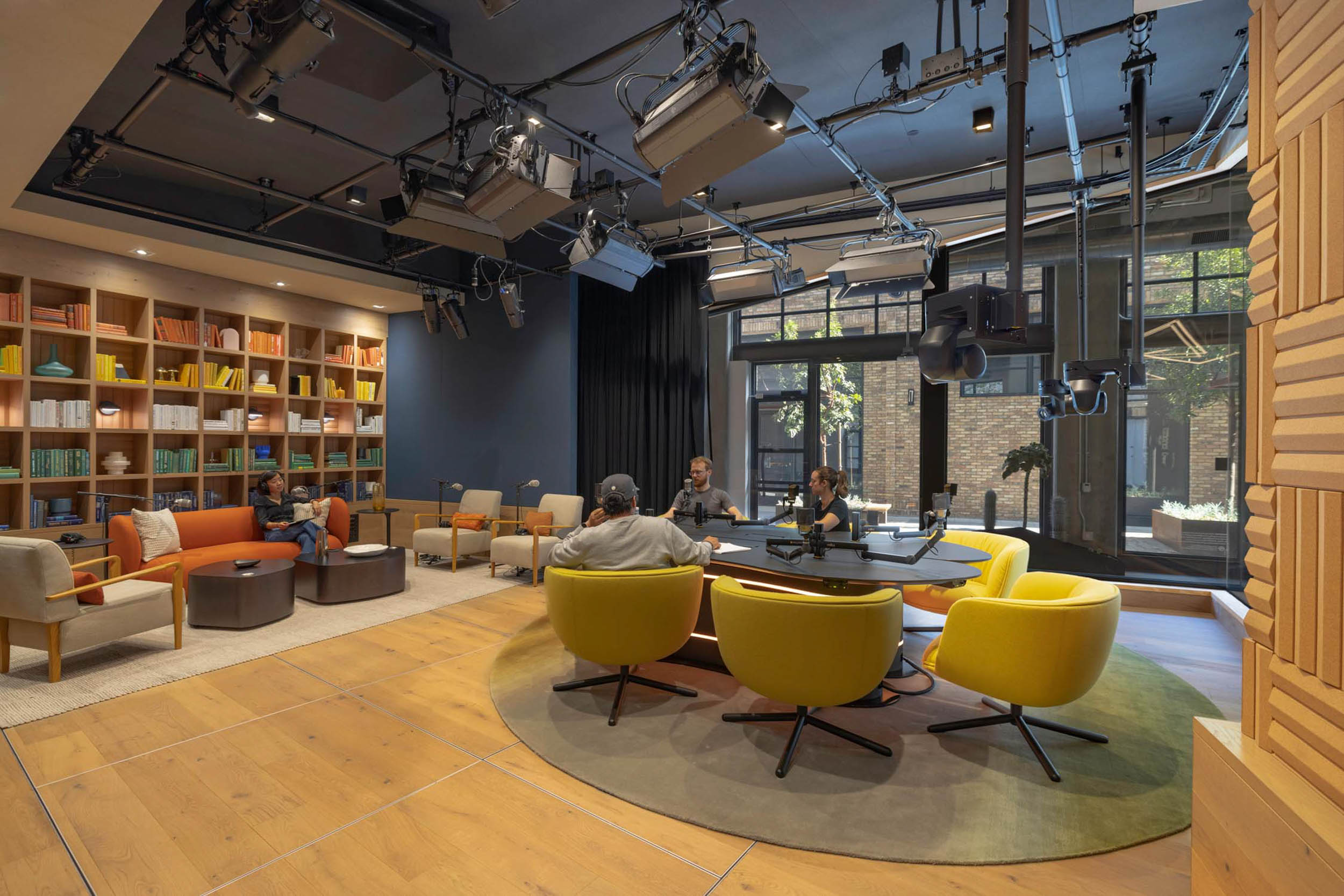
A recording and podcast studio at Spotify's Mateo campus balances production-ready infrastructure with the warmth of a lived-in creative space.
A similar approach occurs at Spotify’s Mateo campus, where highly visible, social spaces anchor the workplace, and specialized creative environments are set apart spatially. Circulation paths and thresholds mediate between those zones, facilitating movement while preserving the distinctions between them.
At Cloud 11’s Creator Studio & Hall in Bangkok, this thinking extends into a full ecosystem, bridging together production studios, workspaces, and venues into a single environment. There, Web3 and Metaverse technologies there help to connect Thai creators with audiences worldwide, and advanced tools including AR, VR, and intelligent lighting help spaces flex through different modes of making, and welcome creativity at all hours.
Though the output at Cloud 11, Spotify, Sony Music Publishing, and other content creation workplaces may differ, one goal is consistent: to build an environment flexible enough to accommodate creative output—whatever it looks like, whenever it happens.
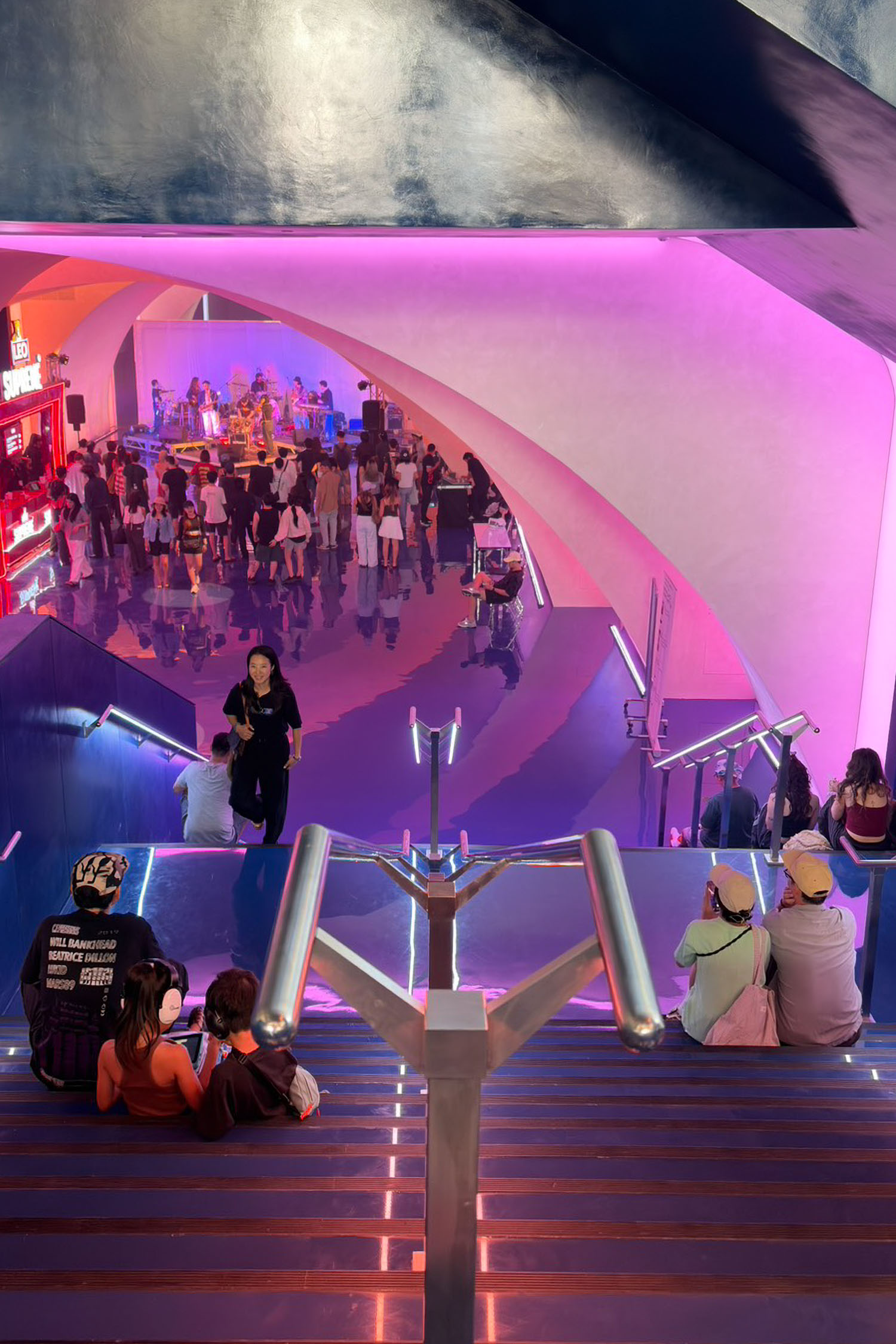
Cloud 11's multi-level performance venue.
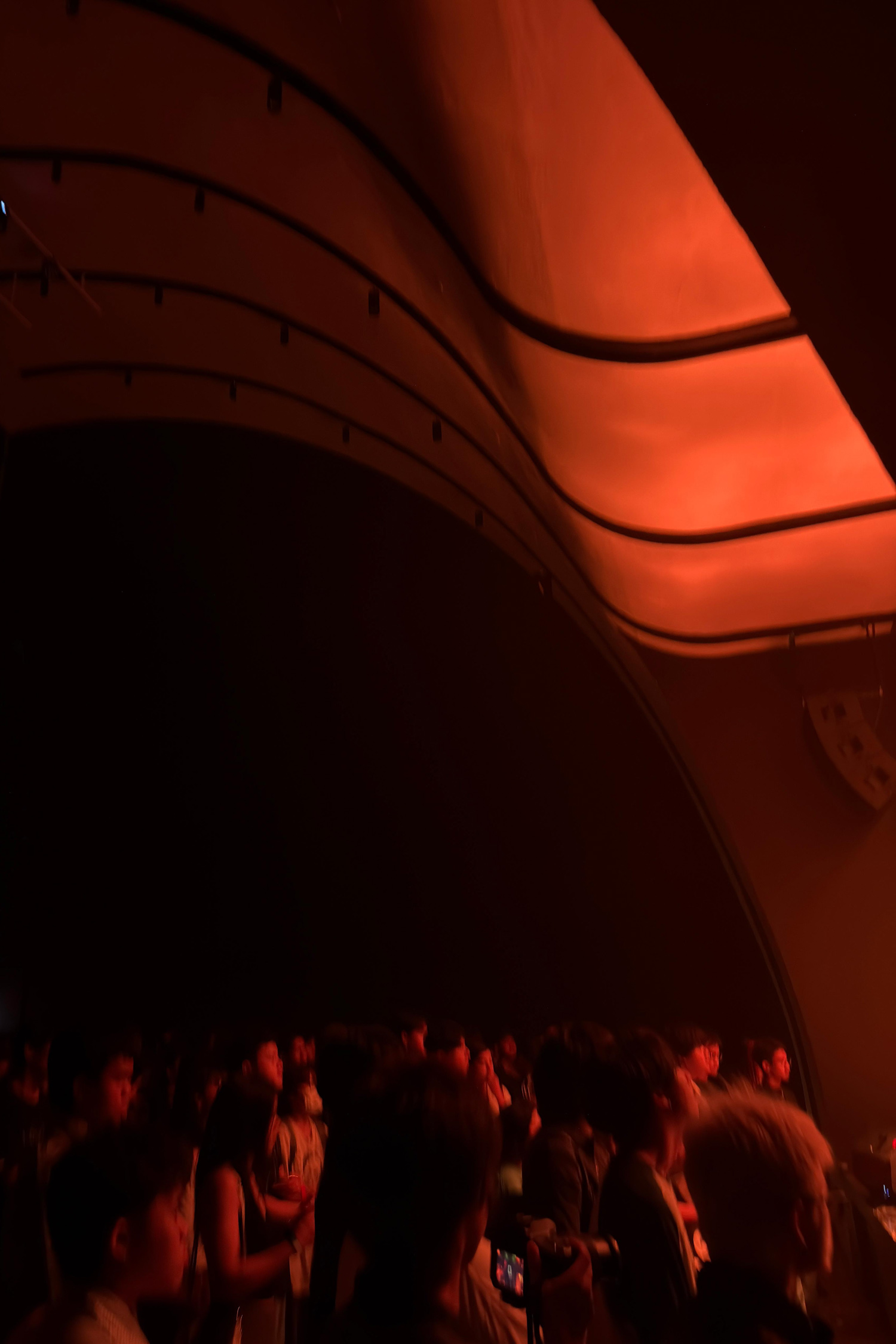
The intimate space at Cloud 11 with intelligent lighting.
Making Room for Spark
Beyond enabling work, these content creation spaces must also ignite it. RIOS’s research has shown that many of the most impactful, generative moments happen outside of designated work zones—in transitions, pauses, and incidental encounters—suggesting that intermediary conditions deserve just as much thought as more formally programmed ones. That gives the threshold a great deal of unspoken power in a creative workplace. Beyond their functional role in circulation, thresholds in RIOS projects are sites for “creative proximity”: active grounds for spontaneous meetings, guard-down creativity, and supported—rather than forced—interaction. RIOS extends these threshold moments, and celebrates them.
At Spotify’s campus at Mateo, this notion of transition extends into a spatial sequence, with workers moving from a bold, visually rich reception area into softer sonic passageways, into a social, coffee-shop “town hall” and tightly tuned listening rooms. In some areas, the corridors between them are dark and soft; in others, the zones are light-filled and more neutral—places where the user, not the design, becomes the main character.
Both physically and psychologically, these thresholds help staffers and creators “buffer” from one state of work to another, while actively contributing to their process. At Sony Music Publishing, for instance, an acoustically tuned threshold between reception and working areas serves as a kind of sonic “palate cleanser”—a place to lock in and prepare for the music-making that lies ahead.
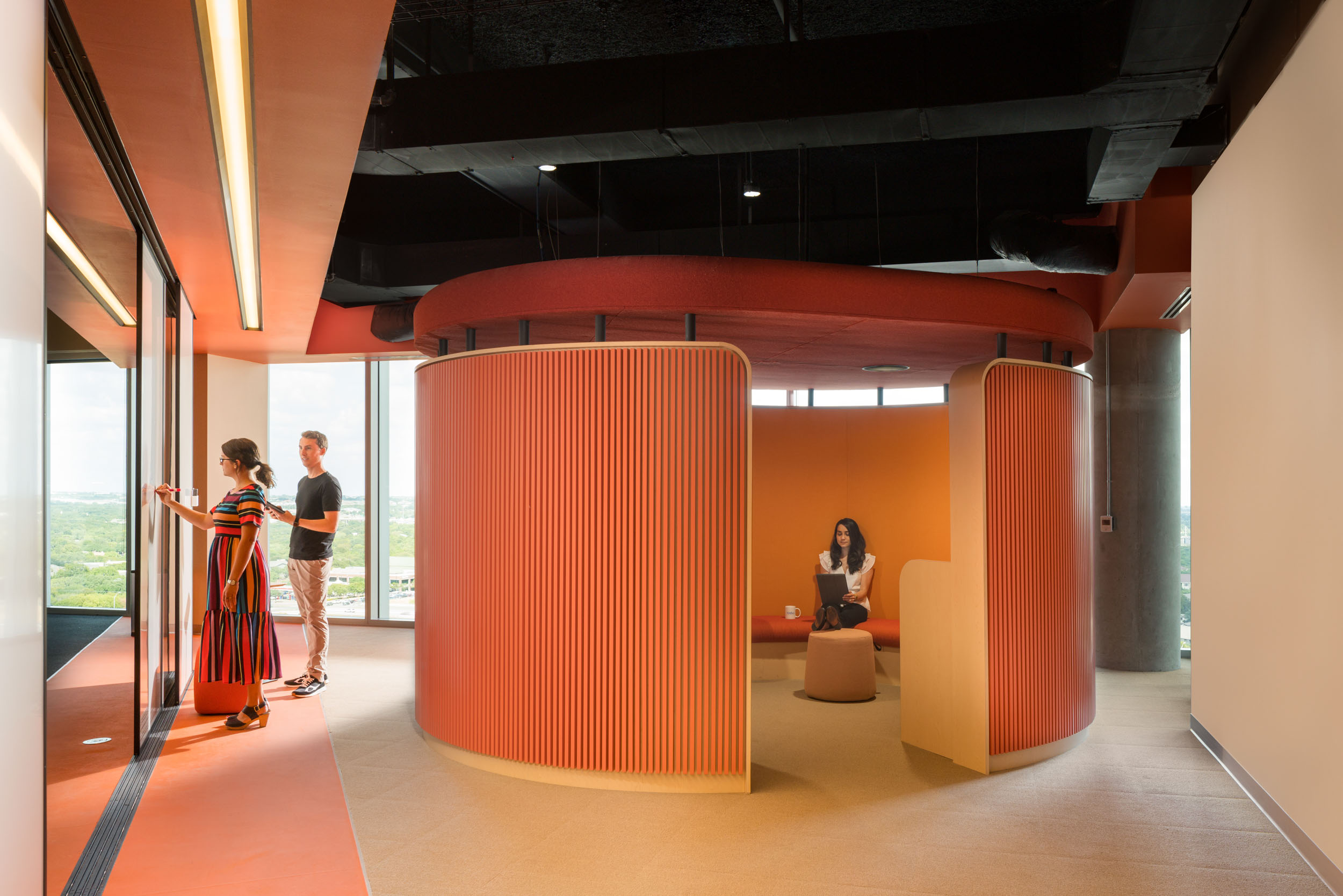
Focus pods and open areas at Vrbo Headquarters are shaped by behavioral research into how teams use the workplace.
Vrbo, another RIOS client, shared similar conditions in its own workplace studies. There, close observation showed exactly how employees navigated their office throughout the day. Certain patterns were clear, such as teams gravitating toward open areas for spontaneous stand-ups, and circulation routes driving how often colleagues connected. That intel shaped the placement of communal amenities and open double-height stairs, improving proximity while maintaining daily workflows.
The threshold condition can even extend to a larger programmatic concept, as it did at Sony Pictures’ Mid-Wilshire campus. As the company consolidated its offices for Sony Pictures Animation, Sony Pictures Imageworks, and Crunchyroll—three subbrands with their own distinct identities—into a unified, vertical workplace, RIOS activated the idea of the threshold in the gathering spaces they shared: reception areas, screening rooms, and coffee zones. Though all of the offices connect aesthetically, they remain singular with buzzy, creative overlap in social areas.
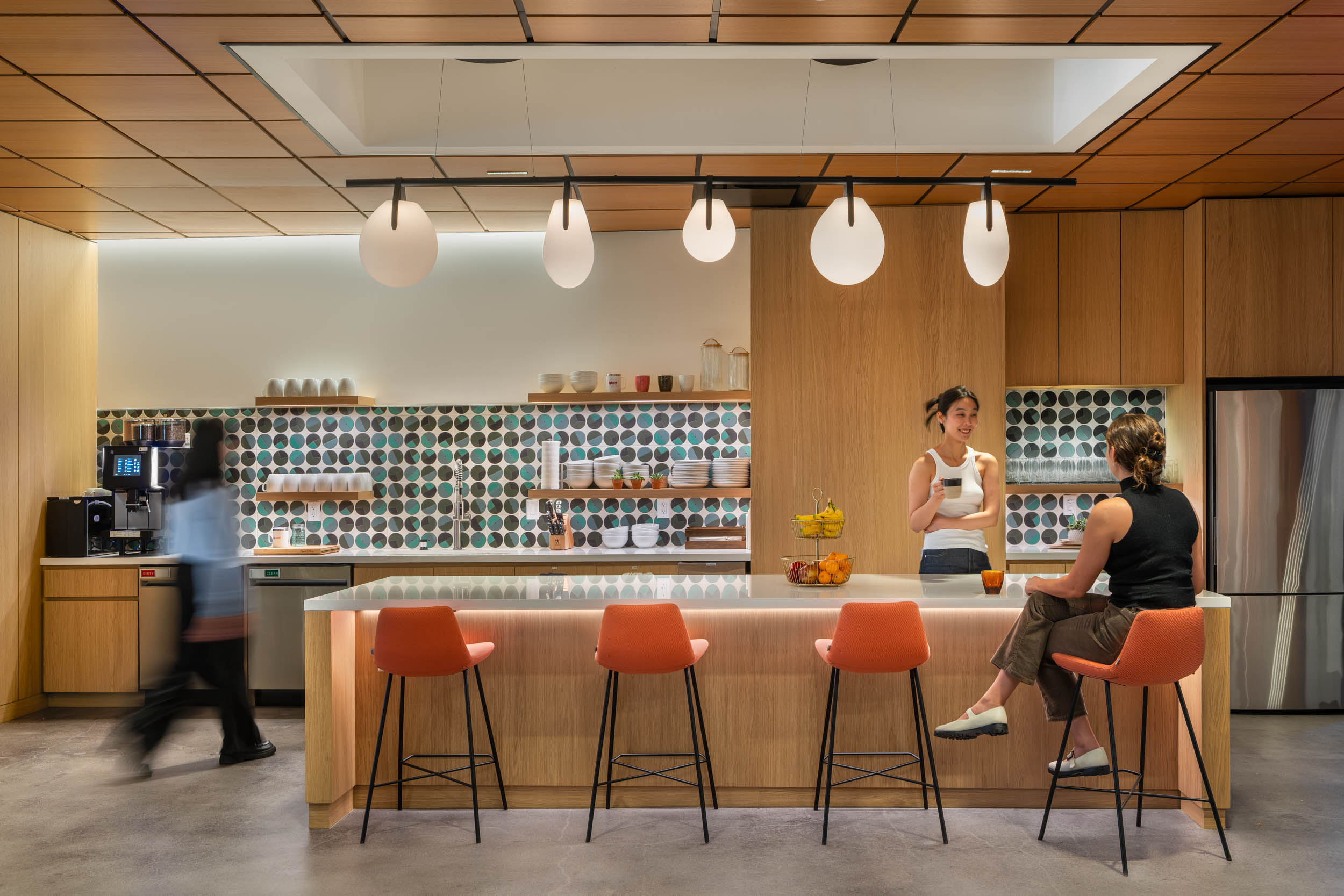
The kitchen at Sony Pictures Mid-Wilshire is designed for the kind of buzzy, informal exchange that happens between the work.
Rising to the Technical Challenge
But no amount of creative proximity can fix lackluster tech. Robust video and sound systems, audio equipment, and even the basics—electrical and internet—are critical ingredients of a content creation workplace. At the same time, those components must be seamlessly woven into workplace design, fading into the background of a space so that workflow remains uninterrupted. Olufowoshe calls this the “invisible infrastructure” of a creative space. “There’s a magic when things just work,” he says. “It sparks a sense of wonder because of how intuitive it feels.”
Doing that successfully requires early and frequent collaboration between architecture and spatial design teams, building-systems consultants, and technology experts. At Spotify’s Mateo campus, RIOS incorporated the expertise of WSDG, a studio designer and acoustician, from the outset to engineer box-in-box construction for sound isolation, set sound isolation targets, and collaborate on Revit drawings and equipment specifications. That dialed-in expertise then enabled the teams to level up at Spotify’s newer Sycamore Studios campus, where technical specifications extend to video, too.
Embedding technology and security experts in meetings with workplace leaders early on is just as essential, notes Freire de Andrade, as those demands can impact spatial layout, access points, and other structural components of an office. The designer—who recently worked on a 146-seat Dolby Atmos® and Dolby Vision® theater for Sony Pictures’ Mid-Wilshire Campus—shares that team efforts like this ultimately mitigate risk, ensuring that performance needs are accounted for in every aspect of a space before it goes to construction.
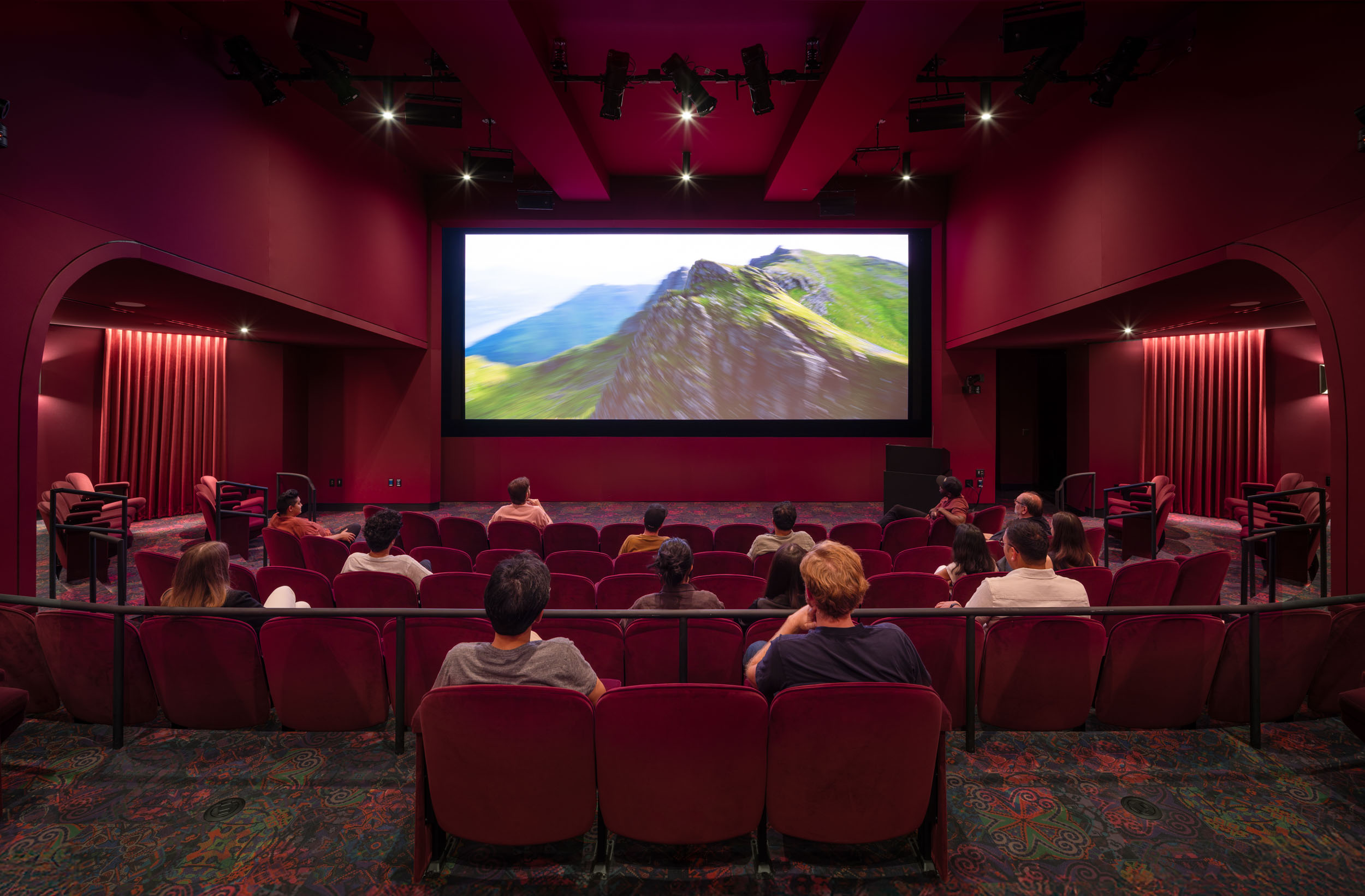
A Dolby Atmos® and Dolby Vision® theater designed for broadcast-quality screening within the workplace.
Designing to Adapt
Though technical components are make-or-break in a content creation workplace, they are also evolving. Just in the past couple of years, a rapid shift has transformed the once audio-only domain of podcasting into a visual medium, bringing with it all-new demands for space and production. Podcasts are going full broadcast, with creators seeing significant growth in video content year over year. That has implications for the workplaces serving those users: Whereas podcast studio design might have prioritized acoustics, speakers, and audio production, a creator-focused video podcast studio must account for lighting rigs, sight lines, expanded crews, green rooms and holding areas, and generous storage for props and furniture. (Shared studios need to flip quickly from one look to another, as creators seek out distinct visual brands.)
Those needs and more informed the design of Sycamore Studios, Spotify’s next-generation content lab. Building on their well-honed expertise from the offices at Mateo, RIOS was able to help the company address the complexities of a video-first environment—but with an eye on what’s ahead.
And “looking ahead” doesn’t necessarily mean predicting the next big culture-shifting technology, says Olufowoshe. “For us, futureproofing is all about designing adaptable infrastructure,” he explains. Some of these moves are deceptively simple: right-sizing rooms for multiple programmatic setups, for instance, is a lesson that holds across budgets, scales, and typologies, even outside of creative industries. Proving the point, RIOS’s proactive thinking has allowed Spotify’s Mateo campus to adapt some of its listening rooms—designed at the time to be flexible, reconfigurable spaces—into video podcasting studios, as demand for that content has swelled.
When change is the only certainty, the workplace that endures won’t necessarily be the one best designed for the moment we’re in. It’ll be the one ready to adapt to what’s next.
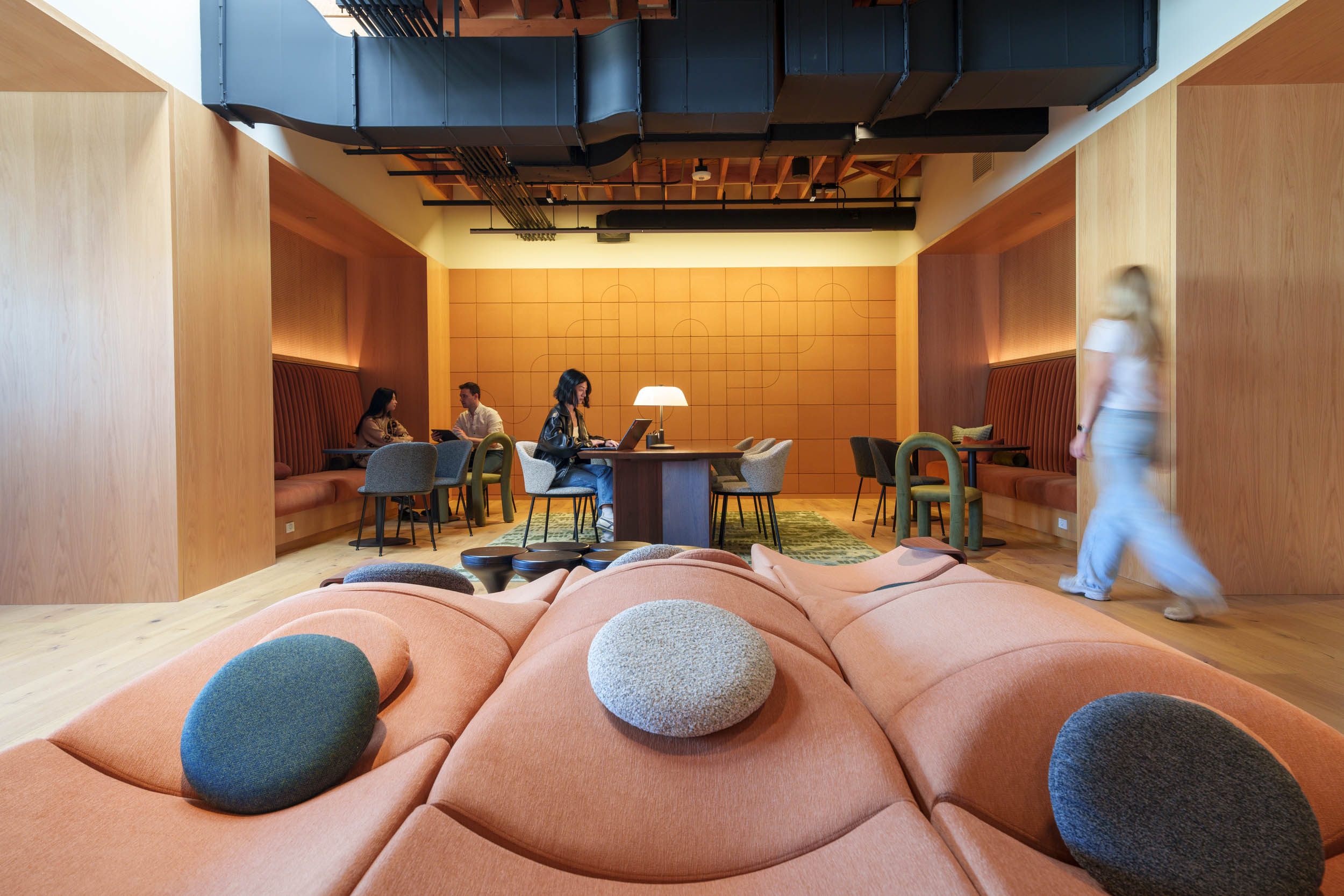
Warm materiality and flexible seating at Sony Music Publishing, a workplace designed to feel worth coming back to.