RIOS on creator spaces in the workplace, from podcast studios to campuses.
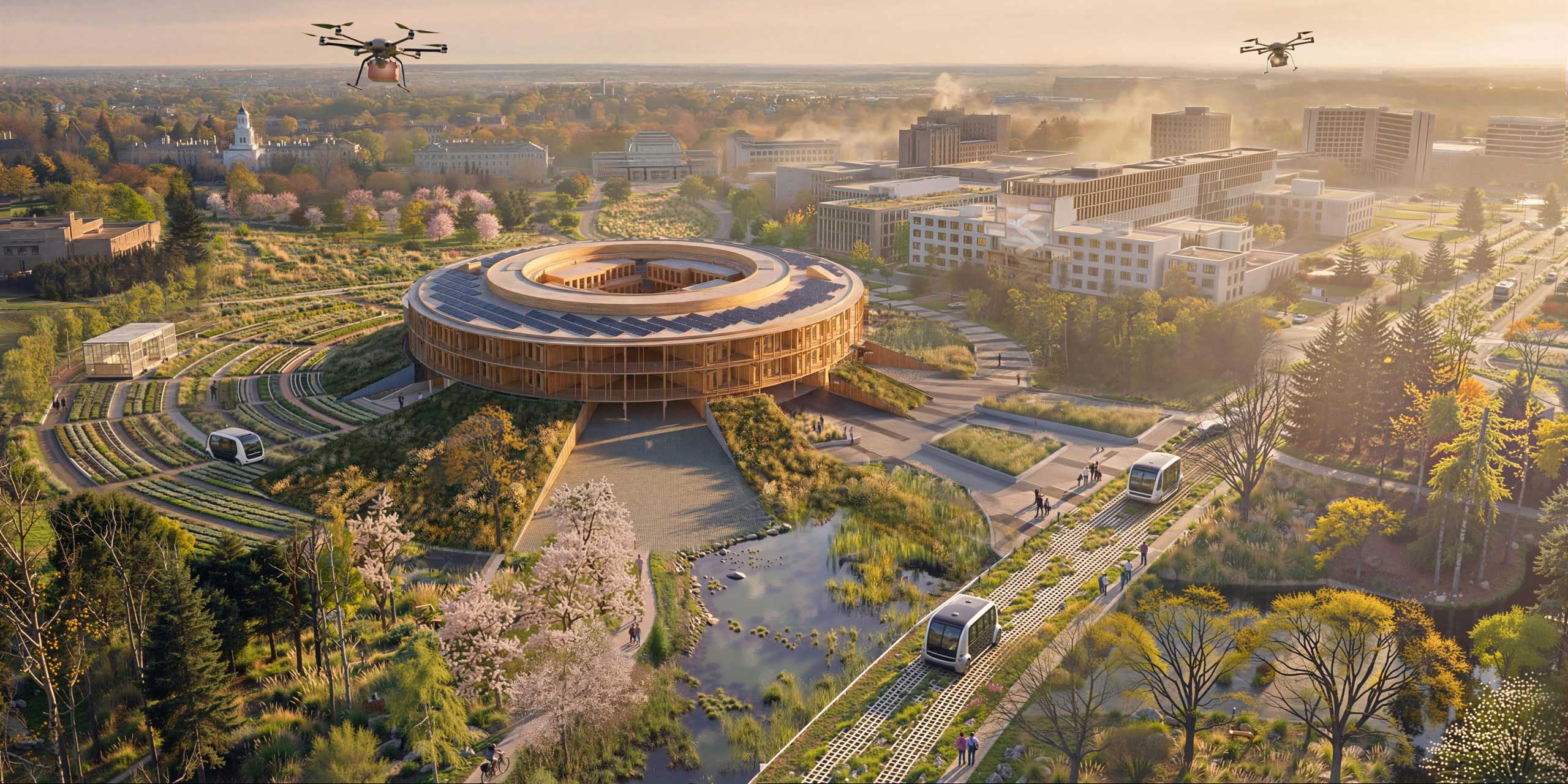
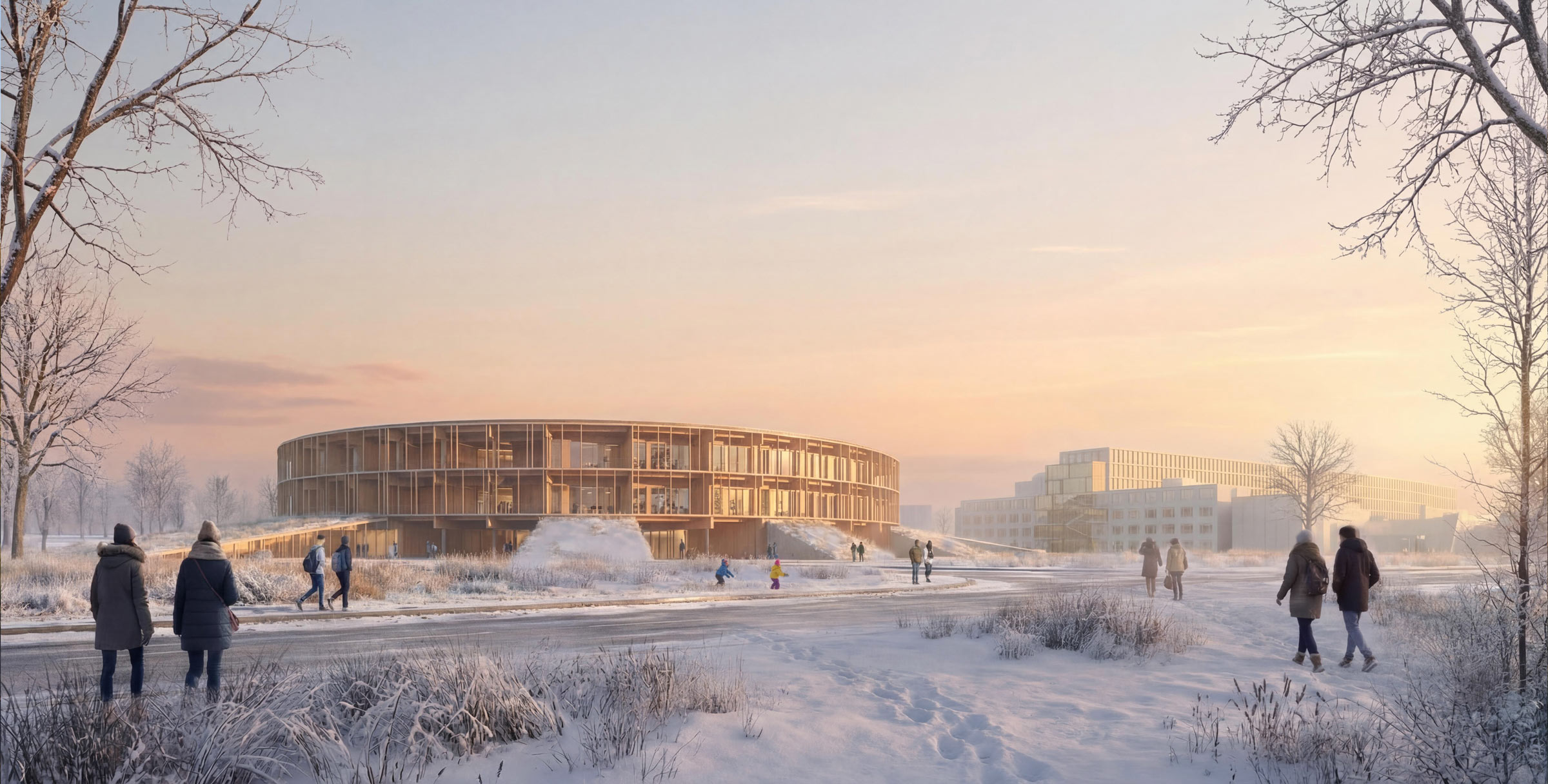
Vision for University at Buffalo's South Campus in 2080 (MVRDV)
The Resilient Campus
A Climate-Resilient Campus
The Resilient Campus is an international competition that transforms the University at Buffalo’s 153-acre South Campus into a climate-adaptive framework. RIOS and MVRDV‘s proposal converts underutilized land into ecological buffers and connected social spaces built to serve campus and city through 2080. The proposal earned recognition as a finalist and honorable mention, offering a replicable landscape design model for campus resilience.
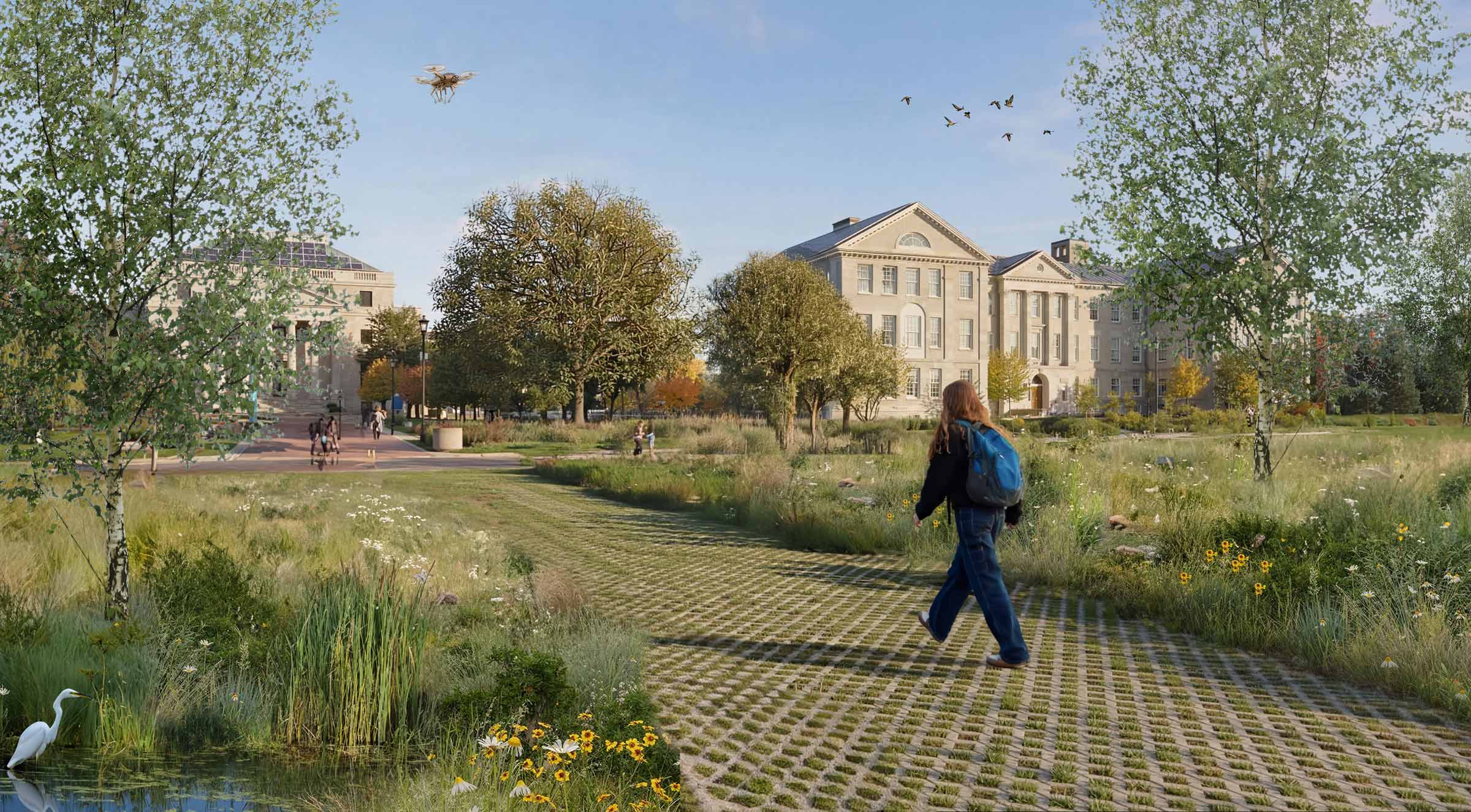
Landscape vision for the South Campus quad in 2080 (RIOS)
Repositioning a Historic Campus
The University at Buffalo sought a vision for South Campus that could respond to changing climate conditions, advance carbon-neutral goals, and address longstanding inequities in access to resources and public space. Buffalo faces intensifying lake-effect storms, variable freeze-thaw cycles, and hotter summers. As a result, the historic campus reflects these conditions: extensive paved surfaces and fragmented open spaces amplify heat and flooding.
With this in mind, RIOS and MVRDV saw an opportunity to reposition the campus as resilient urban infrastructure: a place that manages water, supports biodiversity, advances equity, and prepares for long-term growth as climate migration reshapes settlement patterns across the Great Lakes region. The proposal anticipates that future by creating a campus capable of absorbing change over time while strengthening its role within the city.
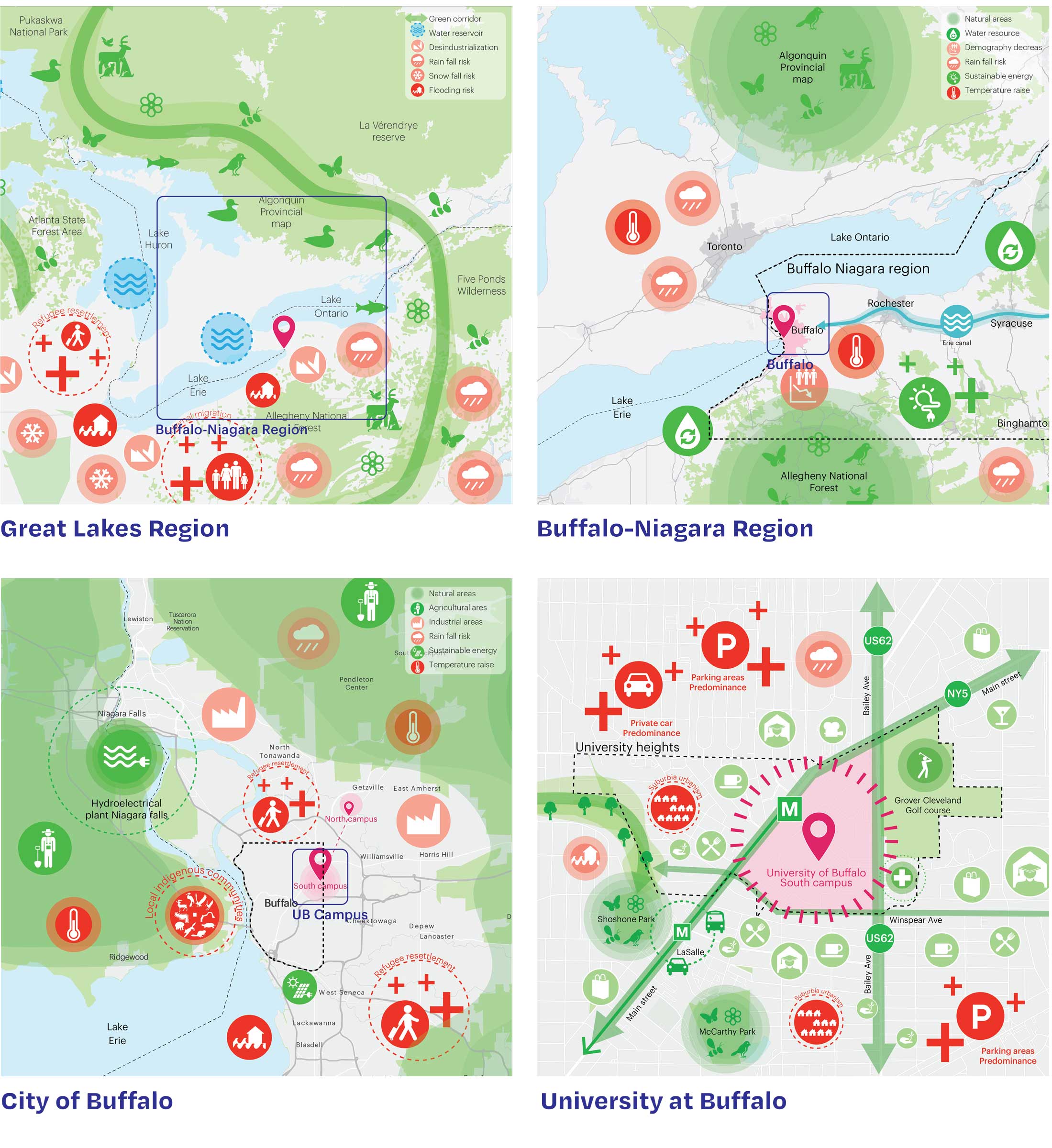
Four scales of analysis reveal interconnected pressures of deindustrialization, climate vulnerability, and inequitable access to resources
Data-Driven Landscape Design
Working with students from the University at Buffalo School of Architecture and Planning, RIOS conducted a comprehensive site analysis that maps seasonal movement patterns, gathering spaces, and informal programs. The analysis revealed where people feel comfortable, where activity concentrates, and how winter and summer conditions transform behavior. In addition, these observations are integrated with microclimatic data to read the campus as an environmental and social system.
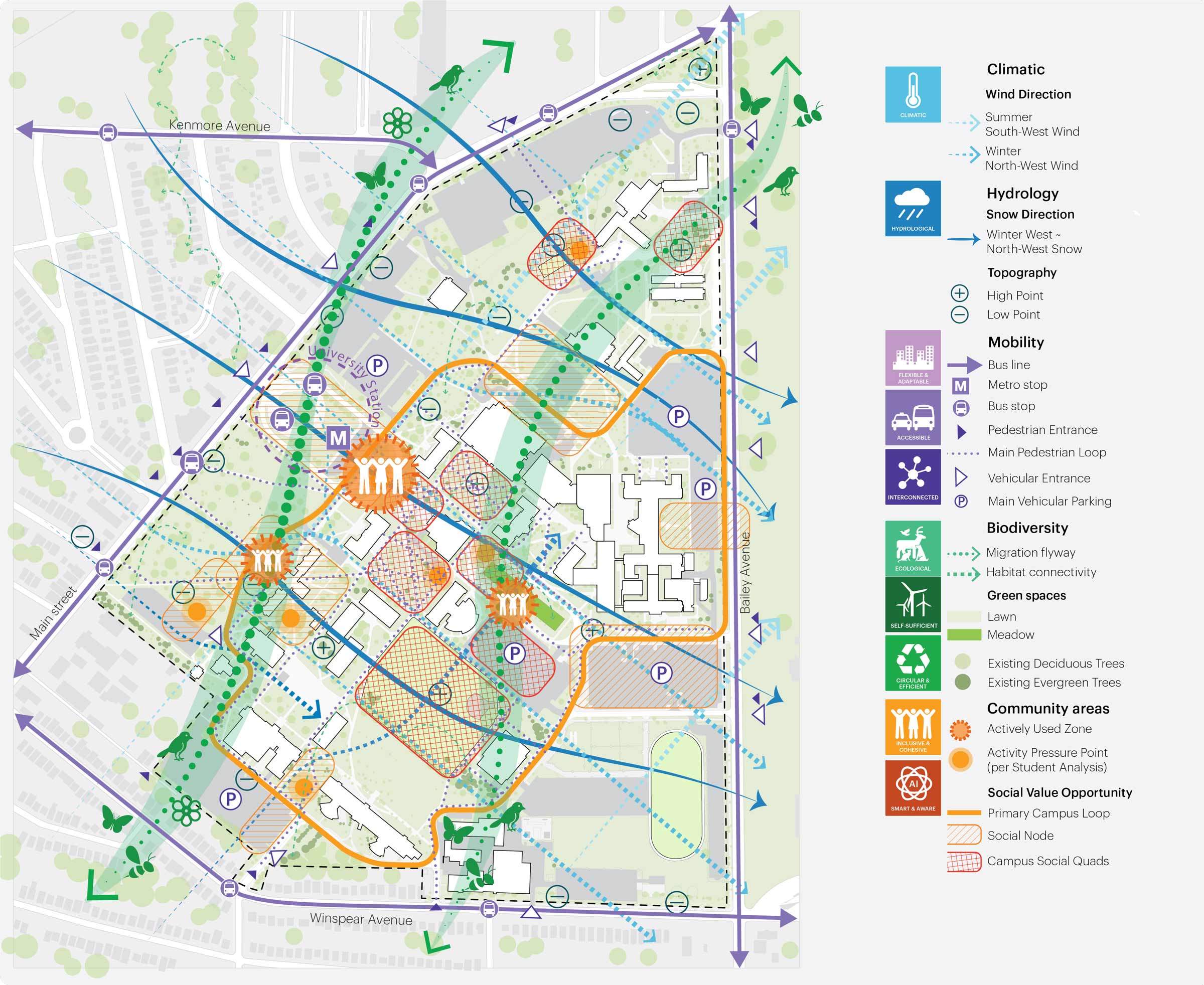
All insights converge in a synthesis map that identifies zones where challenges and opportunities for intervention overlap by connecting climate, hydrology, ecology, accessibility, and circularity. This map informs a patch adaptation strategy: a gridded overlay aligned the with campus’s historic axes and prevailing winds divides the site into measurable units. Each patch is assessed for its potential to become meadow, forest, wetland, productive landscape, or social space. In effect, the strategy shapes key landscape interventions:
A perimeter ecological buffer concentrates biodiversity and climate performance at the campus edges.
A central mobility loop connects new quads and community hubs.
Social nodes integrating wellness, education, community, enterprise, and housing link the campus perimeter to the surrounding city.
Snthesis map overlaying an analysis of climate, hydrology, ecology, mobility, and social spaces across South Campus
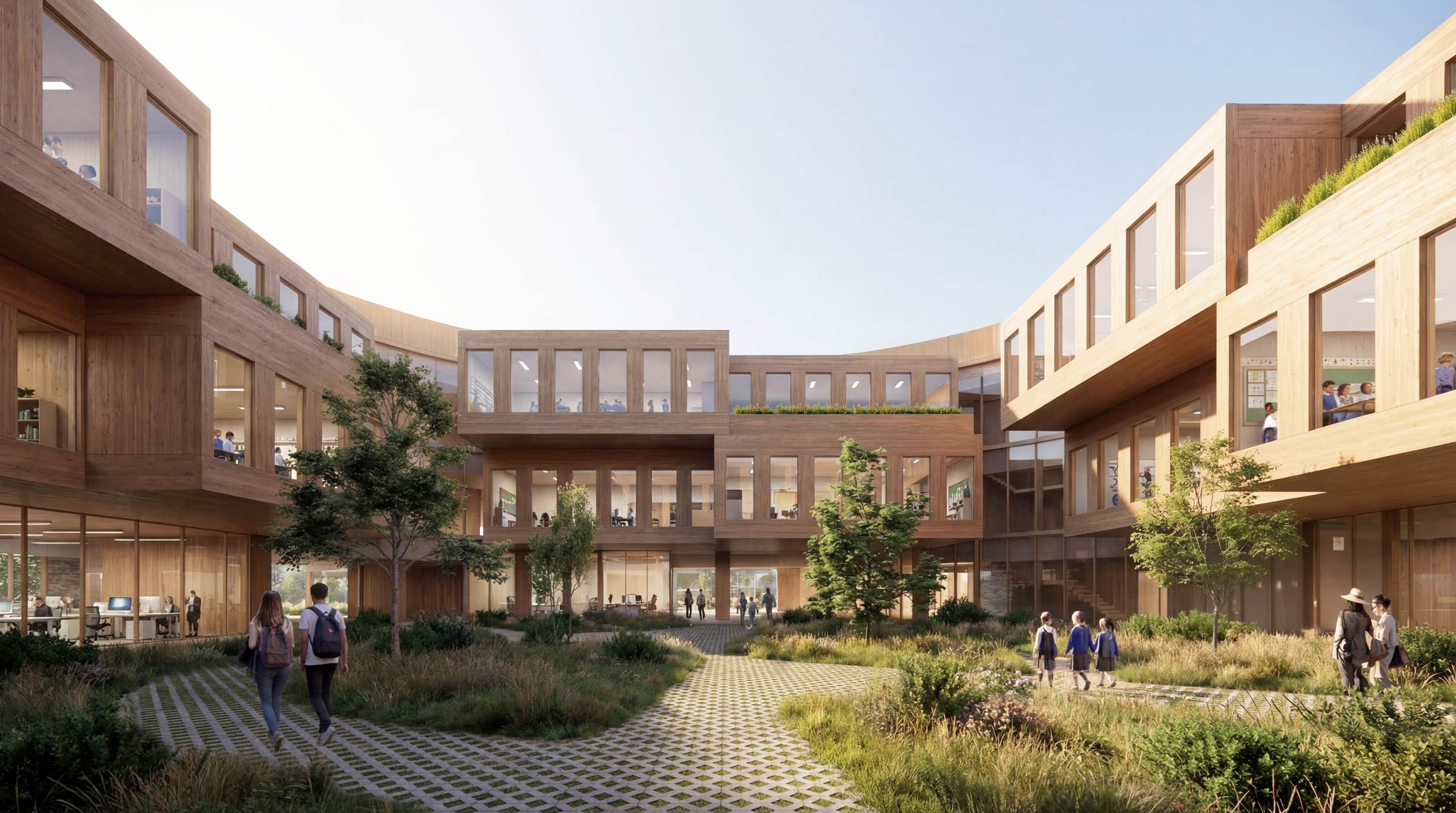
Communal courtyard within a proposed new mass timber building for the university-assisted public school (MVRDV)
A Resilience Framework
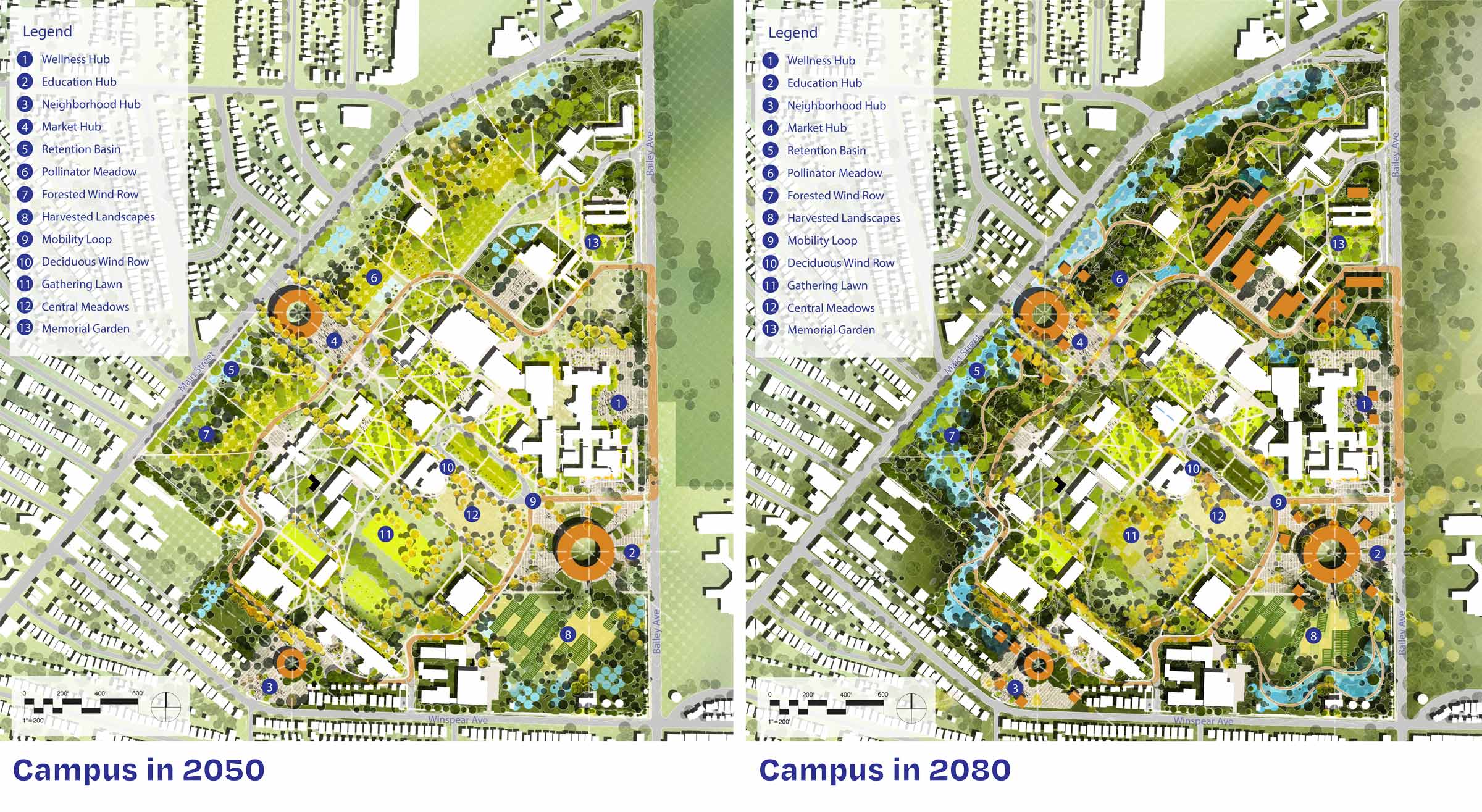
The proposal presents two projected scenarios showing how South Campus transforms into a living laboratory where environmental performance, social well-being, and academic innovation reinforce one another.
Firstly, by 2050, temperatures rise by up to 5°C. This triggers a 15-fold increase in dangerous heat days, a 35% jump in inland flooding risk, and fiercer lake-effect snowstorms. The campus responds with:
Water retention basins that manage increased precipitation and flooding
Tree rows that buffer wind and act as natural snow fences
Expanded social infrastructure serving a growing population drawn to Buffalo as a climate haven
Subsequently, by 2080, 7°C of warming and 95% snowpack loss reshape the water cycle entirely. The campus responds with:
Expanded water infrastructure to manage intensified flooding and runoff
Food production fields and harvestable timber landscapes supporting self-sufficiency
New campus infill accommodating population growth driven by climate migration
In the long run, the patch adaptation framework can scale across thousands of acres of educational campuses, positioning the proposal as a model for campus resilience in North America.